Helping design and engineering professionals discover, evaluate and specify technologies and processes that shorten the design cycle and enable success.


Alert!
Digital Engineering ceased publication on July 1, 2026. This website remains available as an archive of engineering content.
For inquiries or information, please email [email protected].

Digital Engineering April 2026
In the latest issue of Digital Engineering, we take a look at the latest innovations in design for additive manufacturing, including the use of natural language inputs, social media cosplayers, and AI integration. The issue also includes a feature…

January Special Focus Issue: Design for Additive
In this Special Focus Issue of Digital Engineering, learn about the latest advancements in design for additive manufacturing, including new software tools, additive in automotive, custom medical devices, and more.
No, if I’m going to cover the less than savory uses additive manufacturing (AM) has been put to, I’d much rather look at less dangerous aspects. Like printing keys, for example. A group of MIT students have developed a method to replicate high security keys using a 3D printer.
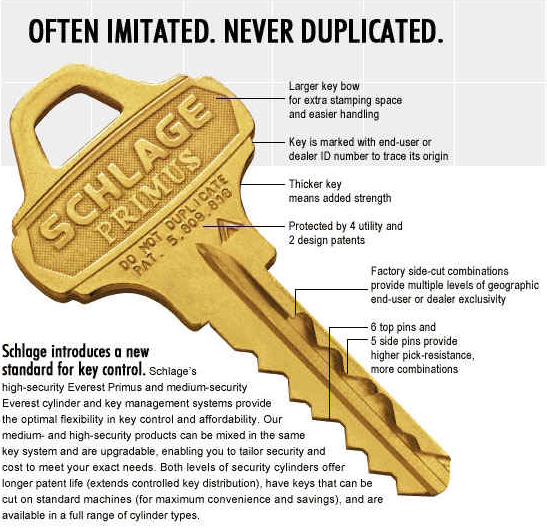
The Primus key lock and key system from Schlage was intended to be difficult to reproduce, down to the, “Do Not Duplicate” warning embedded in every key. Each key features a double row of teeth, something your neighborhood hardware store can’t copy, as part of the design. Schlage lists government agencies, detention centers, and banks among the customers that use Primus keys for security.
Probably much to Schlage’s displeasure, MIT students David Lawrence and Eric Van Albert have developed a bit of code that allows anyone with access to a 3D printer to reproduce these super security keys. Access might not even be that much of a deterrent here. To test their work, the duo sent designs off to the likes of Shapeways and Materialise, and promptly received duplicate keys in a variety of materials, including titanium and nylon.
It is important to note that the program doesn’t produce a Primus skeleton key. You still need a reference to reproduce a key. That can often be easily accomplished with a camera or someone with inside access.
Lawrence and Van Albert say they didn’t create the program to embarrass Schlage, or to make it easier for thieves to gain access to high security areas. They claim what they’ve done is highlight a problem with mechanical locks in a digital age. The duo suggests if companies want the best security, moving to a keycard or biometric system might be the best solution.
Below you’ll find a video that demonstrates a working 3D printed lock and key.
Source: Forbes


John Newman is a Digital Engineering contributor who focuses on 3D printing. Contact him via [email protected] and read his posts on Rapid Ready Technology.
Follow DE






About Us · Contact Us · Editorial Team · Advertising · Privacy Policy · Subscriber Services · © 2026 Digital Engineering 24/7 · Peerless Media