Helping design and engineering professionals discover, evaluate and specify technologies and processes that shorten the design cycle and enable success.


Alert!
Digital Engineering ceased publication on July 1, 2026. This website remains available as an archive of engineering content.
For inquiries or information, please email [email protected].

Digital Engineering April 2026
In the latest issue of Digital Engineering, we take a look at the latest innovations in design for additive manufacturing, including the use of natural language inputs, social media cosplayers, and AI integration. The issue also includes a feature…

January Special Focus Issue: Design for Additive
In this Special Focus Issue of Digital Engineering, learn about the latest advancements in design for additive manufacturing, including new software tools, additive in automotive, custom medical devices, and more.
With the recent supply chain disruptions caused by the global pandemic and the war in Ukraine, companies have been investigating how 3D printing can be used to help re-shore some manufacturing or provide alternatives for creating high-demand parts and products. However, the need for CAD files to create those parts can be an obstacle, particularly for older parts and components.
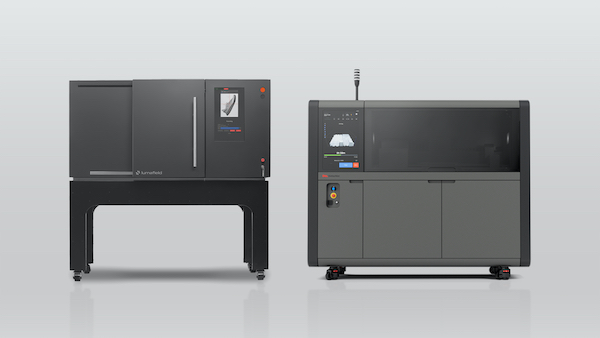
Desktop Metal has teamed up with industrial X-ray/CT scanning specialist Lumafield to create a solution that will allow users to scan and digitize existing parts, and then 3D print copies of those parts on-demand.
While 3D scanning has been used to reverse-engineer older parts, it is limited to external scans. The Supply Chain Resilience package from Desktop Metal and Lumafield uses X-ray cmoputed tomography (CT) scanning by capturing both interal and external features in detail. The solution then uses cloud-based software to create a 3D model that can be exported as a mesh representation for 3D printing.
Desktop Metal’s software and 3D printers can then turn those mesh models back into high-quality metal or polymer parts, making it possible to seamlessly replace legacy manufacturing processes with in-house 3D printing, the company says.
“Manufacturers have wanted to replace legacy fabrication processes with 3D printing for a long time, but digitalization of parts has been a barrier,” said Ric Fulop, Founder and CEO of Desktop Metal. “With accessible CT scanning, we finally have the digitization solution we need to quickly convert old designs into complete CAD files for 3D printing.”
“The last two years have been profoundly disruptive, and we cannot expect our supply chains to return to normal,” said Eduardo Torrealba, Co-Founder and CEO of Lumafield. “Fortunately, we now have the technology to seamlessly bring production in-house, taking control of our supply chains and reducing risk.”
According to the companies, customers interested in pairing a Lumafield scanner with a Desktop Metal printer can customize the solution that best fits their needs.
Desktop Metal printers initially available in this offering include:
All metal printers, including the Desktop Metal Shop System, which was built as a turnkey solution for smaller enterprises and is offered in a 4-, 8-, 12- or 16-liter package. Also included: the Studio System, X-Series and all Production System models, which includes the P-1 and P-50.
All ETEC DLP polymer 3D printing systems, which includes the D4K, P4K, Envision One XL or Xtreme 8K, which offer a wide range of price points, build volumes and potential polymer material sets, including elastomers, hard plastics, high temperature plastics, and biocompatible materials.
The solution also includes Lumafield’s Neptune scanner, which offers a user-friendly touchscreen and AI-powered configuration, so anyone can use it with minimal training, the company says.
Lumafield’s cloud-based Voyager software is included with every Neptune scanner. In addition to producing mesh exports for 3D printing, it offers intuitive visualizations that reveal invisible features, measurement tools, and an automated analysis engine that pinpoints voids, pores, and cracks before they turn into critical problems. Voyager runs in the cloud.
The Supply Chain Resilience package is available to any company that purchases a Desktop Metal 3D printer and reserves a Lumafield CT scanner between May 1 and July 1, 2022. Customers will be entitled to a package benefit of 15 CT scans and application engineering support through Lumafield’s scanning service while they wait for delivery of their Neptune scanner, currently expected to take place in the fourth quarter of 2022.
Sources: Press materials received from the company and additional information gleaned from the company’s website.


Desktop Metal was started to address a problem—how to make metal 3D printing accessible for engineering teams. In 2013, CEO Ric Fulop began collaborating with world-leading experts in materials science, engineering, and 3D printing. Their work…

Brian Albright is the editorial director of Digital Engineering.
Contact him at [email protected].






About Us · Contact Us · Editorial Team · Advertising · Privacy Policy · Subscriber Services · © 2026 Digital Engineering 24/7 · Peerless Media