Helping design and engineering professionals discover, evaluate and specify technologies and processes that shorten the design cycle and enable success.



Digital Engineering April 2026
In the latest issue of Digital Engineering, we take a look at the latest innovations in design for additive manufacturing, including the use of natural language inputs, social media cosplayers, and AI integration. The issue also includes a feature…

January Special Focus Issue: Design for Additive
In this Special Focus Issue of Digital Engineering, learn about the latest advancements in design for additive manufacturing, including new software tools, additive in automotive, custom medical devices, and more.
Kim Matthews was all-hands-on-deck during active duty on submarines, but today, the Navy vet suffers from hand tremors that make the simplest tasks a herculean effort. Yet thanks to a recent design challenge sponsored by the Department of Veteran Affairs, Matthews and other veterans may soon have some relief, spurred by creative-minded individuals wanting to help along with a healthy assist from 3D printing.
The VA Innovation Creation Series for Prosthetics and Assistive Technologies came up with a list of common problems veterans face and challenged individuals with backgrounds in engineering, design, and general problem solving to come up with potential solutions. The idea was to foster an open innovation environment, working with partners like Stratasys to provide a set of tools that would empower problem solvers to turn their ideas into working prototypes.
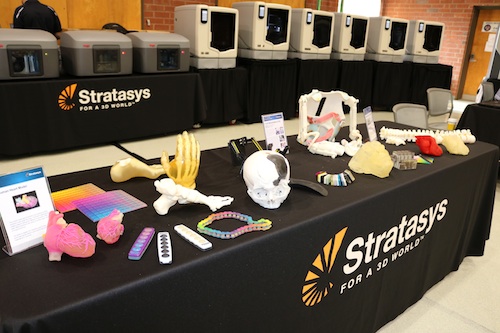 As partner in the VA Innovation Creation Series, Stratasys aims to accelerate the development of personalized technologies to improve care and quality of life for veterans. Image Courtesy of Stratasys
"Being able to rapidly prototype new designs is something 3D printing is clearly well suited towards," said Michael Gaisford, marketing program manager for medical solutions at Stratasys. "You have complete design freedom with 3D printing—groups were able to come to us with some wild idea and test it out without having to bring in 20 different types of fabrication equipment and machines."
The five challenges the teams set out to address were:
About 125 people participated in the two-day design challenge held in late July. At their disposal were a variety of design tools, including 14 Stratasys 3D printers, from the high-end Fortus 450mc production-class machines to lower end Mojo and Makerbots. Designs were submitted through GrabCAD, Stratasys' open source 3D modeling and collaboration platform.
One glove design, in particular, has real potential to help Matthews with her hand tremors. The glove provides stability, allowing Matthews to better control her hand movements so she can perform essential job-related skills like typing as well as handle simple every day tasks like buttoning blouses, even drinking coffee.
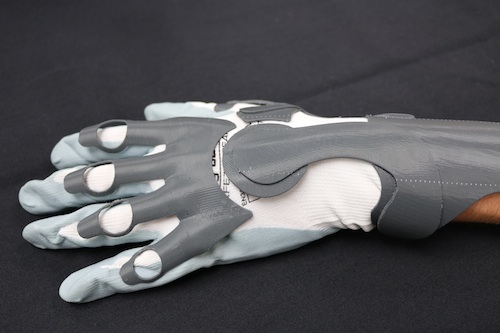 This glove, designed to provide stability for hand tremors, aims to improve veteran Kim Matthews' ability to perform everyday tasks. Image Courtesy of Stratasys
Matthews, who raised three kids and works as an administrative assistant, is hopeful that the designs coming out of this challenge will address vets' issues, leading to better quality of life.
"A lot of these inventions have big potential, not just to help me, but to help other veterans who are far worse off," she said. "To have something that makes you feel like a human being and a woman is important. We just want to feel normal, and these inventions allow us that capability."


Beth Stackpole is a contributing editor to Digital Engineering. Send e-mail about this article to [email protected].
Follow DE
Join over 90,000 engineering professionals who get fresh engineering news as soon as it is published.






About Us · Contact Us · Editorial Team · Advertising · Privacy Policy · Subscriber Services · © 2026 Digital Engineering 24/7 · Peerless Media