Helping design and engineering professionals discover, evaluate and specify technologies and processes that shorten the design cycle and enable success.




Digital Engineering April 2026
In the latest issue of Digital Engineering, we take a look at the latest innovations in design for additive manufacturing, including the use of natural language inputs, social media cosplayers, and AI integration. The issue also includes a feature…

January Special Focus Issue: Design for Additive
In this Special Focus Issue of Digital Engineering, learn about the latest advancements in design for additive manufacturing, including new software tools, additive in automotive, custom medical devices, and more.
 Jenny Chen M.D., founder and CEO of 3DHEALS, which focuses on 3D printing in healthcare (image courtesy of Jennifer Chen).
Though originally a rapid prototyping technology for engineers and designers, 3D printing has also attracted the attention of doctors, dentists, and surgeons. The technology offers new ways to produce prosthetics, implants, and artificial limbs. Therefore, a partnership between 3D printing and healthcare is not an unlikely marriage.
3DHEALS 2017, a conference taking place in San Francisco next week (April 20, Mission Bay Conference Center), will explore the link between the two. This is the fifth conference curated by the organizers.
But if AM vendors want to court the healthcare industry, they may have to do a much better job in outreach, education, training, and user interface redesign.
Jenny Chen, a trained neuroradiologist and the founder/CEO of 3DHEALS, says, "Most healthcare providers’ knowledge on AM or 3D printing remains limited on what is available in the media, i.e. some high-profile user cases ... Currently, systematic 3D printing education in healthcare is only available to selected dental schools, residencies, and a few CME (continued medical education) courses, like the Mayo Clinic and RSNA (Radiological Society of North America). Even with these educational programs, the curriculum is still in its infancy as the teaching institutes are continuing to learn about the technology themselves."
The adoption of AM in healthcare also depends on regulatory and institutional acceptance. The U.S. Food & Drug Administration (FDA) has begun certifying certain 3D printing materials and processes for medical use. (For more on this subject, read "Materials: 3D Printing's Medical Miracles," October 2015).
"Healthcare is a highly-regulated field, for good reasons," says Chen. "There are quite a few concerns that the additive manufacture industry and healthcare professionals need to address before the technology can be fully implemented. These include: material safety/toxicity (esp. in biological systems), manufacturing standards (including safety and quality control), liability, and efficacy.
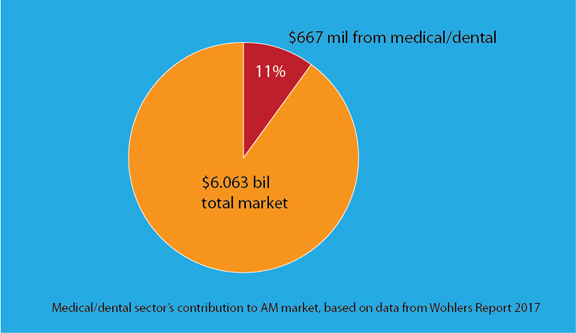 According to Wohlers Associate's 2017 report on the 3D printing market, the medical/dental sector contributed roughly 11% to the overall market revenue (chart created by DE based on data from Wohlers Assoc.).

Kenneth Wong is Digital Engineering's resident blogger and senior editor. Email him at [email protected] or share your thoughts or suggestions at digitaleng.news/facebook.
Follow DE
Join over 90,000 engineering professionals who get fresh engineering news as soon as it is published.






About Us · Contact Us · Editorial Team · Advertising · Privacy Policy · Subscriber Services · © 2026 Digital Engineering 24/7 · Peerless Media