Helping design and engineering professionals discover, evaluate and specify technologies and processes that shorten the design cycle and enable success.



Digital Engineering April 2026
In the latest issue of Digital Engineering, we take a look at the latest innovations in design for additive manufacturing, including the use of natural language inputs, social media cosplayers, and AI integration. The issue also includes a feature…

January Special Focus Issue: Design for Additive
In this Special Focus Issue of Digital Engineering, learn about the latest advancements in design for additive manufacturing, including new software tools, additive in automotive, custom medical devices, and more.
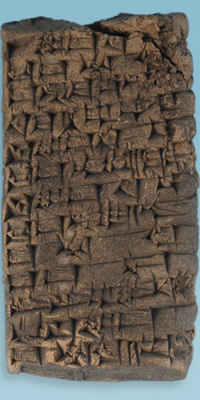 Scientists at the University of Pisa, Assyriology Department and Italian Agency for New Technologies, Energy and the Environment (ENEA), Pisa, Italy have joined forces to conceive of a project entitled “Duplication and Rebirth” – to recreate replicas of 5,000-year-old Iraqi cuneiform tablets using rapid prototyping laser scanning techniques.
Dating from the Mesopotamian era, the tablets are now inaccessible due to the closing of the National Museum in Baghdad, Iraq, as a result of heavy looting. Currently the physical tablets are held in rooms behind iron doors that have been welded shut, according to Robert Englund, who teaches at the department of Near Eastern Languages and Culture of the University of California, Los Angeles. Englund, also the director of the Cuneiform Digital Library (http://cdli.ucla.edu/), a project to make the form and content of cuneiform tablets available online, is curious as to how the Italian researchers will set up the rapid prototyping equipment in the museum, given the high security issues and sporadic electricity that is currently available.
Researchers want to preserve what was left of the Iraqi museums, and plan to use laser scanning to make reproductions of the tablets from a collection of photographs and references of tablets held in other collections. It is estimated that there are close to 5 million tablets buried throughout Iraq, and 500,000 more of them in museums and collections around the world.
The cuneiform tablets hold enormous cultural importance for the Iraqi people, as they document how people lived for millennia in ancient Mesopotamia. They represent the method by which people described codes of law, treatises and economic transactions, dating from around 3350 B.C., which is understood as the beginning of the written word, until the end of the pre-Christian era. Digitally capturing the tablets will help safeguard the country’s heritage.
Universityof Pisa
Pisa, Italy
Italian Agency for New Technologies, Energy and the Environment
Pisa, Italy
Sources: Press materials received from the company and additional information gleaned from the company’s website.


DE's editors contribute news and new product announcements to Digital Engineering. Press releases may be sent to them via [email protected].
Follow DE
Join over 90,000 engineering professionals who get fresh engineering news as soon as it is published.






About Us · Contact Us · Editorial Team · Advertising · Privacy Policy · Subscriber Services · © 2026 Digital Engineering 24/7 · Peerless Media