Helping design and engineering professionals discover, evaluate and specify technologies and processes that shorten the design cycle and enable success.


May 2026 Special Focus: Artificial Intelligence in Design and Simulation
In this Special Focus Issue, learn about the latest developments in the integration of artificial intelligence into engineering workflows.

Design & Simulation Software Guide 2025
In this Special Issue, Digital Engineering presents its second annual guide to design and simulation software vendors.
Digital simulation is becoming a regular feature of the certification process with the two main regulatory bodies for commercial aerospace operations, the U.S. Federal Aviation Administration (FAA) and the European Union Aviation Safety Agency (EASA).
“They routinely accept a combination of analysis, including modeling and simulation techniques, and targeted test data as part of compliance demonstration,” says Brice Segaud, senior technical account manager, Synopsys, “This has become a standard part of most certification programs.”
However, the process is not straightforward. It usually involves rounds of back and forth, months or years of iterations and revisions, in the experience of Thierry Olbrechts, senior director Simcenter Aerospace, Defense, and Marine Industry Solutions, Siemens. He described it as “a continuous negotiation, involving simulation and tests.”
“Under both EASA and FAA rules, ‘an application for type certification of a transport-category aircraft is effective for five years’ and ‘an application for any other type certificate is effective for three years,’” says Segaud. “In practice, programs often run longer, and authorities routinely extend these windows to accommodate the complexity of modern designs.”
It’s important to note that regulatory bodies “do not certify the tools you use,” says Olbrechts. In other words, there’s no preapproved list of FEA [finite element analysis] or CFD [computational fluid dynamics] software titles you can pick from.
“They certify the data, process, and method you use to get the data. So in essence, you could use hand calculation, Excel spreadsheets, or advanced digital simulation,” he says. The regulatory bodies want to see “sufficient proof that your calculations and methods produce results that match reality.” Olbrechts felt that Siemens, straddling both simulation as well as manufacturing, is ideally positioned to connect the virtual and physical worlds with digital twins.
In general, it’s comparatively simpler and faster to certify a variant of a previously approved design than to submit a new or radically different design. Evidence for a previously certified design already exists, so you only need to supply proof for the alteration: for example, the flame-retardant quality of the new material you’re proposing as a substitute. Certification is an important way to ensure safety in air travel; however, the time and efforts required to certify something new might also discourage innovation.
The development of the electric vertical take-off and landing (eVTOL) aircraft, which some see as the future of air taxis, is a case study in this difficult balance. In August 2025, regarding the FAA Advisory Circular AC 21.17-4, the civil aviation news portal AIN reported, “While the agency’s long-awaited initiative doesn’t guarantee certifications will now be completed in short order, it does at least appear to clear a path to the finish line for what is set to be the first new class of aircraft since the first half of the 20th century.” (“FAA Clears eVTOL Certification Path with Powered-lift Rules,” August 2025, Charles Alcock).
Olbrechts described it as a common challenge for companies exploring greenfield technology. “You can simulate an electric motor in a detailed fashion to satisfy FAA requirements, but in this case, there are other integration issues,” he explains. “You will have an electromagnetic coupling between the high current cables and the very sensitive sensor cables that measure the air data. You’d need data and testing to prove it’s safe.”
Most of the routine events and potentially catastrophic events an aircraft might encounter can be replicated in digital simulation, making it the most practical way to verify the craft’s ability to cope with them or survive them. Segaud outlined these examples with the relevant simulation regimens as follows:
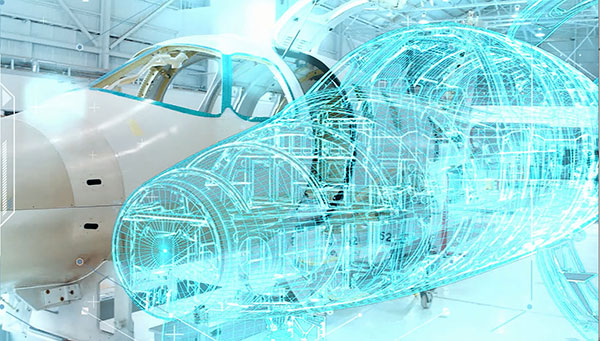
Thierry Olbrechts, senior director Simcenter Aerospace, Defense, and Marine Industry Solutions, Siemens, describes regulatory requirement satisfaction as “a continuous negotiation, involving simulation and tests.”Image courtesy of Siemens.
Segaud also points out that certain types of tests are simply too costly and impractical to perform in reality; therefore, digital simulation is the norm. For example, for a fan blade-out (FBO) test, you would have to “deliberately release a fan or turbine blade at full rotational speed to verify containment, resulting in the total destruction of a multimillion-dollar engine,” he says.
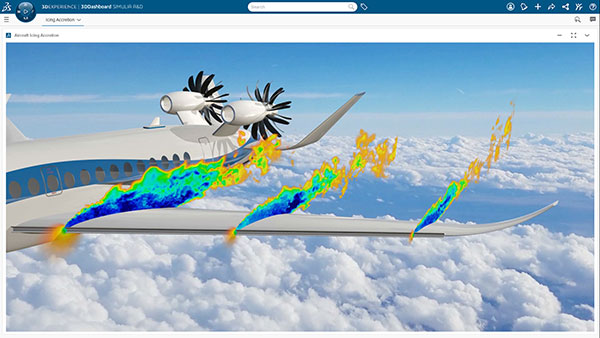
Similarly, a crashworthiness or impact test would require you to crash the aircraft—or, at least, an expensive sensor-equipped prototype. And the icing test requires you to fly to a site with the precise atmospheric conditions (matching the prescribed temperature, altitude, humidity, and droplet size), while hoping the weather holds until you get there.
“One of our customers told me they have dedicated teams basically watching the weather map and to identify where they can fly to, to prove that the aircraft can still safely land with severe ice buildup on the wing,” says Swen Noelting, director, SIMULIA A&D Experience Management, Dassault Systèmes.
For structure-related tests, Noelting proposed Dassault Systèmes’ Abaqus solver, part of the SIMULIA portfolio. “For fluid dynamics, we have PowerFLOW, used by our aerospace customers both for aerodynamics, noise and icing certifications. For electromagnetic compatibility verification, to make sure the plane is protected from events like lightning strikes, we have CST Studio Suite.”
Dassault Systèmes promotes MODSIM: Unified Modeling and Simulation on the 3DEXPERIENCE platform.
“Having all the data in one place with traceability on the 3DEXPERIENCE platform is a huge benefit, so certification engineers can talk to the stress analysts,” says Chandresh Zinzuwadia, Aerospace and Defense Business Value Consultant, Dassault Systèmes, adds. “The combination of Dassault Systèmes’ brand solutions on the platform provides a unified approach to digital certification, including the management of design and simulation data, governance of methods, and documentation of verification and validation processes.”
With hardware and software supporting machine learning on the rise, ROMs are now becoming part of simulation workflow. In some cases, due to their speed and efficiency, ROMs are slowly replacing full-physics simulations. The regulatory bodies do not have any specific rules regarding the use of ROMs, but “You might face more questions because the reliability of these ROMs are not yet fully understood,” says Olbrechts. Similarly, Zinzuwadia adds, “[The regulatory officials] will likely ask you about the limitations of the ROM—where it’s applicable, where it’s not.”
“Reduced order models (ROMs) and surrogate models can be used, especially to accelerate development, explore large design spaces, or integrate physics into 0D/1D systems simulations,” says Segaud. “What matters is that the method shows appropriate correlations with test or historical data, and they were used within the intended range of applicability.”
ROMs run faster than full physics-based simulations, but experts have warned that their reliability is reduced when used outside the scenarios covered in the training data set.
“Minor modifications, derivative models, or evolutions of aircrafts, engines, or systems are usually the first areas where analysis begins to replace the physical test burden,” Segaud observes. “For new designs, we are not yet at the point where physical testing can be eliminated. Final validation through targeted physical tests is still required to establish confidence and satisfy regulatory expectations.” Likewise, Olbrechts says, “There’s no denying that simulation can help you speed up certification, but that doesn’t mean you can skip the physical tests.”


Simcenter™ software, from Siemens Digital Industries Software, uniquely combines system simulation, 3D CAE and test to help you predict performance across all critical attributes earlier and throughout the entire product lifecycle. By combining…
Making the Case for Artificial Intelligence and Machine Learning in Engineering
In this paper, Siemens Digital Industries Software and Digital Engineering will provide an overview of how AI/ML-enabled software can improve design workflows, while also addressing common questions and concerns around implementing this technology in an engineering organization.

Kenneth Wong is Digital Engineering's resident blogger and senior editor. Email him at [email protected] or share your thoughts or suggestions at digitaleng.news/facebook.
Follow DE
Join over 90,000 engineering professionals who get fresh engineering news as soon as it is published.






About Us · Contact Us · Editorial Team · Advertising · Privacy Policy · Subscriber Services · © 2026 Digital Engineering 24/7 · Peerless Media