Helping design and engineering professionals discover, evaluate and specify technologies and processes that shorten the design cycle and enable success.


Alert!
Digital Engineering ceased publication on July 1, 2026. This website remains available as an archive of engineering content.
For inquiries or information, please email [email protected].


Sponsored

Artificial Intelligence for Design and Engineering Workflows
In this white paper, learn how artificial intelligence and machine learning can improve design and simulation.
Technology Focus: Designing for Optimization & Simulation
Simulation is pervasive, with people from different departments and backgrounds discovering new ways to put it to use, in all of its varied forms.
In the past decade, simulation has become an increasingly important part of the design cycle. Companies have found that by incorporating simulation in the early stages of product design, they can optimize their products, reduce failure rates, and save costs through reduced prototyping and test.
In a recent webinar (Faster Engineering Innovation with Accelerated Computing), experts from Dell Technologies, NVIDIA, and SimuTech Group discussed how GPU acceleration has revolutionized engineering by making it faster and easier for more stakeholders to take advantage of simulation across the design cycle, while also improving design quality.
“[Incorporating simulation] earlier in the design cycle can make the producer better in terms of quality and reliability,” said Himanshu Iyer, Manufacturing Industry Lead at NVIDIA. “We are going through a major transformation because of GPU-accelerated computing. Engineers can run more simulations faster and test more iterations. We see the industry rapidly employing the use of this technology to make the whole design cycle more streamlined, and to optimize products before they are sent to the prototyping or manufacturing stage.”
“What simulation has allowed us to do is solve problems that we couldn’t previously solve,” said Dr. Nathan Bushnell, Director of Engineering, SimuTech. “Simulation allows us to get to prototypes sooner that will pass testing; allow us to understand what is happening when products fail; and to truly understand the entire design space.”
Iyer went on to note that the end goal in many industries is to create a real-time digital twin of a part, system or assembly to provide real-time feedback to help continually improve designs. “We are still on that journey, but without simulation, there are no digital twins,” he said.
Workstation hardware is a key component of enabling these types of innovations. In the past, many engineers were compute-constrained because of the limits of CPU-based computing. As more software providers have re-architected their solvers to take advantage of GPU acceleration, it has unlocked the ability to not only run simulations faster, but also to tackle larger and more complex problems at scale.
“GPUs can run trillions of calculations,” Iyer said. “That leads to higher throughput, and the ability for engineers to run higher fidelity models and run more design iterations.” During the presentation, Iyer showed a video that provided an overview of the wide variety of solvers from Ansys, now part of Synopsys, that take advantage of GPU acceleration.
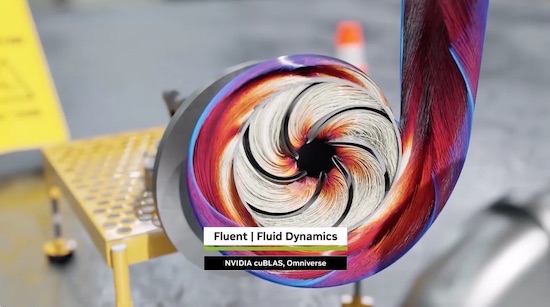
“Hardware enablement can be a barrier to entry,” said Ken Flannigan, Industry Alliances and Solutions at Dell Technologies. “You need to have the right NVIDIA RTX Pro GPUs. This is a powerful way to explore simulation, not just in the specialist role, but across the entire organization." (You can learn more about NVIDIA professional GPUs available on Dell workstations here.)
That accelerated computing is even more important as artificial intelligence (AI) is incorporated into simulation workflows. With AI tools, engineers can use existing simulation data to train new models that can provide even faster analysis.
For example, Bushnell noted that Ansys SimAI allows engineers to rapidly predict the behavior of new designs in just seconds. AI is also being leveraged for support and chatbot functionality within simulation software tools, as well as to improve and accelerate coding.
Faster, more frequent, and higher resolution simulation also provides real business value. Coapnesi can build better products faster via simulation. Designs can be more fully optimized for requirements, and failure rates can be reduced.
And the use of simulation is only going to increase as new types of simulation tools are introduced, from the design phase all the way through manufacturing. “Having the right compute capability and hardware to run more types of simulation will essentially make the products we use better and more reliable,” Iyer said.
You can view the webinar here.


DE's editors contribute news and new product announcements to Digital Engineering. Press releases may be sent to them via [email protected].
Follow DE






About Us · Contact Us · Editorial Team · Advertising · Privacy Policy · Subscriber Services · © 2026 Digital Engineering 24/7 · Peerless Media