Helping design and engineering professionals discover, evaluate and specify technologies and processes that shorten the design cycle and enable success.


Alert!
Digital Engineering ceased publication on July 1, 2026. This website remains available as an archive of engineering content.
For inquiries or information, please email [email protected].
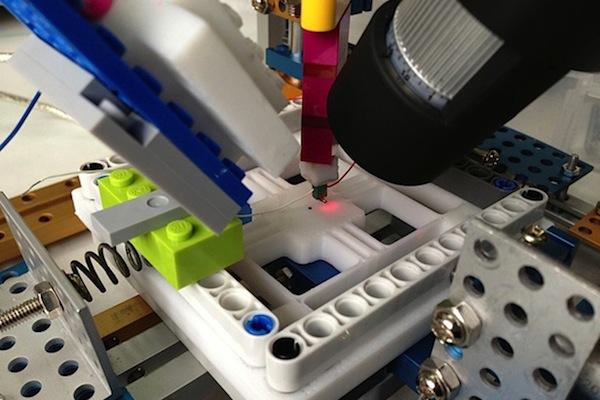

Digital Engineering April 2026
In the latest issue of Digital Engineering, we take a look at the latest innovations in design for additive manufacturing, including the use of natural language inputs, social media cosplayers, and AI integration. The issue also includes a feature…

January Special Focus Issue: Design for Additive
In this Special Focus Issue of Digital Engineering, learn about the latest advancements in design for additive manufacturing, including new software tools, additive in automotive, custom medical devices, and more.
Low-cost prosthetics are just one example of how AM can be employed to build functional products at a fraction of the usual price. Now, students from Tsinghua University, Peking University and University College London teamed up with the LEGO Foundation to develop another low-cost alternative product. Using LEGO, 3D printed parts, an Arduino board, and commonly available electronics, the students were able to build a functioning atomic force microscope (AFM).
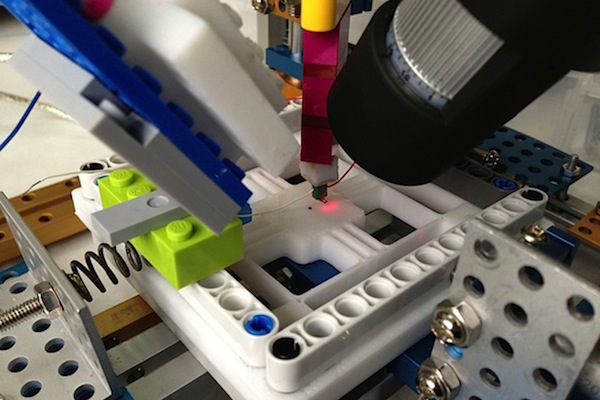
An AFM is almost like a 3D scanner for nanoscale structures. It functions by noting the distance between the tip of the AFM probe arm and whatever object it is measuring. Repeated passes generate a 3D map of the object, giving scientists a chance to see nanoscale objects.
The LEGO AFM has 3D printed component holders and a scanning stage to go along with piezoelectric actuators controlled by Arduino processors and LEGO housings. Where most AFMs cost around $100,000 to purchase, the AFM developed by the students can be assembled for around $500.
The project hopes to make these microscopes available to children around the world, giving them a chance to see three-dimensional models of biological samples. Both the LEGO Foundation and the project team hope to inspire younger students to take a greater interest in science by giving them access to images beyond the standard 2D pictures found in textbooks.
Projects like this one lead me to believe that most schools would profit by having a 3D printer on site. Not only could they kids use the AM system to help build an AFM, but the information gathered could also be fed back into the printer to build 3D models of what had been scanned. That’s the sort of interactive education that grabs a child’s interest and keeps it.
Below you’ll find a short video about how AFMs work.
Sources: Wired, University College London


John Newman is a Digital Engineering contributor who focuses on 3D printing. Contact him via [email protected] and read his posts on Rapid Ready Technology.
Follow DE






About Us · Contact Us · Editorial Team · Advertising · Privacy Policy · Subscriber Services · © 2026 Digital Engineering 24/7 · Peerless Media