Helping design and engineering professionals discover, evaluate and specify technologies and processes that shorten the design cycle and enable success.



May 2026 Special Focus: Artificial Intelligence in Design and Simulation
In this Special Focus Issue, learn about the latest developments in the integration of artificial intelligence into engineering workflows.

Design & Simulation Software Guide 2025
In this Special Issue, Digital Engineering presents its second annual guide to design and simulation software vendors.
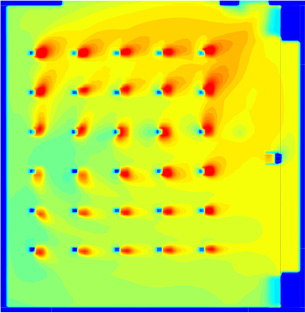 Thermal image produced using FloVENT software showing the introduction of cooled air, body heat displacement from class students, and the projected convection paths using the proposed thermal displacement ventilation (TDV) technique. |
AECOM (Los Angeles, CA) consultants used FloVENT computational fluid dynamics (CFD) software from the Mentor Graphics Mechanical Analysis Division (formerly Flomerics) to determine the viability of and guidelines for the use of thermal displacement ventilation (TDV) for schools in Southern California. AECOM used FloVENT CFD software, which is designed specially for building interior spaces, to simulate the use of TDV in various classroom configurations. TDV demonstrated the ability to provide comfortable classrooms at energy consumption levels considerably lower than conventional air conditioning systems.
TDV works by introducing cool air at around 65°F, compared to 55°F for a standard mixed system, at low velocity at a low level by using either a raised floor or terminals around the perimeter of the space. Sources of heat such as people and equipment warm the air, causing it to rise and take with it moisture and contaminants such as carbon dioxide from people. Compared to a standard mixing system, TDV reduces energy consumption because it is only necessary to cool the occupied zone. The hours in the year when free cooling is available are also far greater for a TDV system than for a mixed system with economizer. The reason is that the supply air temperature is considerably higher than in a mixed system.
FloVENT was used to analyze otherwise identical classrooms with different ceiling heights to establish a minimum that could be used as a filtering process for which schools, or classrooms within schools could use this technology.
After developing guidelines for the use of TDV, AECOM installed TDV in a few pilot schools. TDV demonstrated the ability to provide comfortable classrooms at energy consumption levels considerably lower than conventional air conditioning systems. With the guidelines in place, competitive bidding will be used to select contractors to install TDV in the remaining schools based on the guidelines.
For more information, visit Mentor Graphics.
For previous DE coverage, see “Mentor Graphics Acquires Flomerics Group PLC,” (Nov. 2008).
Sources: Press materials received from the company and additional information gleaned from the company’s website.


DE's editors contribute news and new product announcements to Digital Engineering. Press releases may be sent to them via [email protected].
Follow DE
Join over 90,000 engineering professionals who get fresh engineering news as soon as it is published.






About Us · Contact Us · Editorial Team · Advertising · Privacy Policy · Subscriber Services · © 2026 Digital Engineering 24/7 · Peerless Media