Helping design and engineering professionals discover, evaluate and specify technologies and processes that shorten the design cycle and enable success.


Alert!
Digital Engineering ceased publication on July 1, 2026. This website remains available as an archive of engineering content.
For inquiries or information, please email [email protected].


Cut Retrieval-Augmented Generation (RAG) Hallucinations by 50%
Most teams hit the same wall with enterprise AI: LLMs that hallucinate, pipelines that don’t scale, and infrastructure that’s harder to design than the models themselves.

What Is Intelligent BOM Management? A Guide to Smarter Product Development
Learn how intelligent Bill of Materials (BOM) management helps teams collaborate, reduce errors, and bring innovative products to market faster with cloud-based PLM tools.
Altair and researchers from the Technical University of Munich have made a breakthrough in quantum computing for computational fluid dynamics (CFD). The breakthrough, published in the journal Computer Physics Communications, presents runnable code for quantum computers and quantum simulators that overcomes several challenges of the quantum computing implementation of the Lattice-Boltzmann Method (LBM).
The paper, titled "Quantum Algorithm for the Lattice-Boltzmann Method Advection-Diffusion Equation," was developed under a research grant from Altair and driven by researchers from the Technical University of Munich. The paper was co-authored by Altair Vice President of CFD Solutions Christian Janssen and former Altair Chief Technology Officer Uwe Schramm.
"Our GPU-powered CFD tools have set the standard for efficiency and accuracy," says Christian Janssen, vice president of CFD solutions, Altair. . "Now, we're exploring the revolutionary potential of quantum computing to tackle even more complex simulations, opening up new possibilities for innovation in product design and engineering."
The research presents a generic quantum CFD algorithm for three-dimensional (3D) CFD. The algorithm may be able to bring fully nonlinear 3D CFD to the quantum world. The findings reportedly demonstrate the possibilities in model size and scalability that quantum computing offers compared to classical computing, according to Altair.
The project's objective was to develop an algorithm for quantum CFD using the LBM. Making classical CFD compatible with quantum mechanics allows users to leverage quantum computing's processing power for simulations that are exponentially faster and potentially more accurate than classical computations, according to Altair.
"This is an important discovery for both our team and the Altair researchers, one that has the potential to open a new dimension of quantum computing," says Nikolaus Adams, professor and chair of aerodynamics and fluid mechanics, Technical University of Munich. "We have presented the building blocks for a new generation of quantum computing algorithms, which will hopefully bring more practical quantum computing applications to the forefront in both industry and academia."
As discussed in a similar paper, today's quantum computing algorithms are developed at the deep machine level by designing quantum circuits. Classical CFD is non-unitary and non-linear, while quantum formulations are unitary and linear. The research found a unitary transformation for classical CFD in addition to developing a machine learning approach for the non-linear aspect.
The paper's authors include the Technical University of Munich's David Wawrzyniak, Josef Winter, Steffen Schmidt, Thomas Indinger, and Nikolaus A. Adams, alongside Janssen and Schramm. All quantum computing was performed at the Leibniz Supercomputing Centre, near Munich, Germany, on the Atos QLM system.
This research is the latest in a string of developments catalyzed by Altair's investment in quantum computing. Altair has also invested in Riverlane, a company specializing in making quantum computing more robust and more practical by solving quantum error correction (QEC) challenges. Headquartered in Cambridge, UK, Riverlane is known for Deltaflow, a QEC stack helping quantum computers reach scale to execute error-corrected quantum applications.
Click here to read the full paper: "Quantum Algorithm for the Lattice-Boltzmann Method Advection-Diffusion Equation." To learn more about Altair's CFD solutions, visit https://altair.com/altair-cfd.
Sources: Press materials received from the company and additional information gleaned from the company’s website.


Altair transforms design and decision making by applying simulation, machine learning, and optimization throughout product lifecycles. Altair offers software in five categories related to Computer Aided Engineering (CAE) and High Performance…
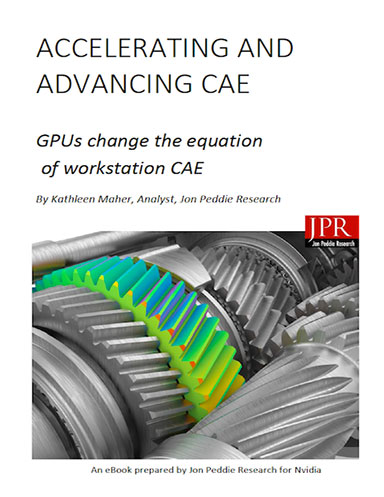
Accelerating and Advancing CAE
GPUs are changing the nature of engineering simulation, according to a new ebook from Jon Peddie Research (JPR). It explains how GPU acceleration is improving CAE workflows.

DE's editors contribute news and new product announcements to Digital Engineering. Press releases may be sent to them via [email protected].
Follow DE
Join over 90,000 engineering professionals who get fresh engineering news as soon as it is published.






About Us · Contact Us · Editorial Team · Advertising · Privacy Policy · Subscriber Services · © 2026 Digital Engineering 24/7 · Peerless Media