Helping design and engineering professionals discover, evaluate and specify technologies and processes that shorten the design cycle and enable success.




Cut Retrieval-Augmented Generation (RAG) Hallucinations by 50%
Most teams hit the same wall with enterprise AI: LLMs that hallucinate, pipelines that don’t scale, and infrastructure that’s harder to design than the models themselves.
What Is Intelligent BOM Management? A Guide to Smarter Product Development
Learn how intelligent Bill of Materials (BOM) management helps teams collaborate, reduce errors, and bring innovative products to market faster with cloud-based PLM tools.
AMD has an expanded collaboration with HPE to accelerate the next generation of open, scalable AI infrastructure built on AMD leadership compute technologies. HPE will become one of the first system providers to adopt the AMD “Helios” rack-scale AI architecture, which will integrate a purpose-built HPE Juniper Networking scale-up switch—in collaboration with Broadcom—and software for high-bandwidth connectivity over Ethernet.
“Helios” combines AMD EPYC CPUs, AMD Instinct GPUs, AMD Pensando advanced networking and the AMD ROCm open software stack to deliver a cohesive platform.
“HPE has been an exceptional long-term partner to AMD, working with us to redefine what is possible in high-performance computing,” says Dr. Lisa Su, chair and CEO, AMD. “With ‘Helios’, we’re taking that collaboration further, bringing together the full stack of AMD compute technologies and HPE’s system innovation to deliver an open, rack-scale AI platform that drives new levels of efficiency, scalability, and breakthrough performance for our customers in the AI era.”
“For more than a decade, HPE and AMD have pushed the boundaries of supercomputing, delivering multiple exascale-class systems and championing open standards that accelerate innovation,” says Antonio Neri, president and CEO at HPE. “With the introduction of the new AMD ‘Helios’ and our purpose-built HPE scale-up networking solution, we are providing our cloud service provider customers with faster deployments, greater flexibility, and reduced risk in how they scale AI computing in their businesses.”
The AMD “Helios” rack-scale AI platform delivers up to 2.9 exaFLOPS of FP4 performance per rack using AMD Instinct MI455X GPUs, next-generation AMD EPYC “Venice” CPUs and AMD Pensando Vulcano NICs for scale-out networking, all unified through the open ROCm software ecosystem.
Built on the OCP Open Rack Wide design, “Helios” can help customers and partners streamline deployment timelines and deliver a scalable, flexible solution for AI workloads.
This has enabled HPE to integrate differentiated technologies for their customers, specifically a scale-up Ethernet switch and software designed for “Helios.” Developed in collaboration with Broadcom, the switch delivers optimized performance for AI workloads using the Ultra Accelerator Link over Ethernet (UALoE) standard.
HPE will offer the AMD “Helios” AI Rack-Scale Architecture worldwide in 2026.
Herder, a new supercomputer for the High-Performance Computing Center Stuttgart (HLRS) in Germany, is powered by AMD Instinct MI430X GPUs and next-generation AMD EPYC “Venice” CPUs. Built on the HPE Cray Supercomputing GX5000 platform, Herder will offer performance and efficiency for HPC and AI workloads at scale.
The combination of the AMD leadership compute portfolio with HPE’s system design will create a new tool for sovereign scientific discovery and industrial innovation for European researchers and enterprises.
Delivery of Herder is scheduled for the second half of 2027 and it is expected to go into service by the end of 2027. Herder will replace HLRS's current flagship supercomputer, called Hunter.
Sources: Press materials received from the company and additional information gleaned from the company’s website.


AMD, or Advanced Micro Devices, has driven innovation in high-performance computing, graphics and visualization technologies. They develop high-performance computing and visualization products to solve some of the world’s toughest and most…
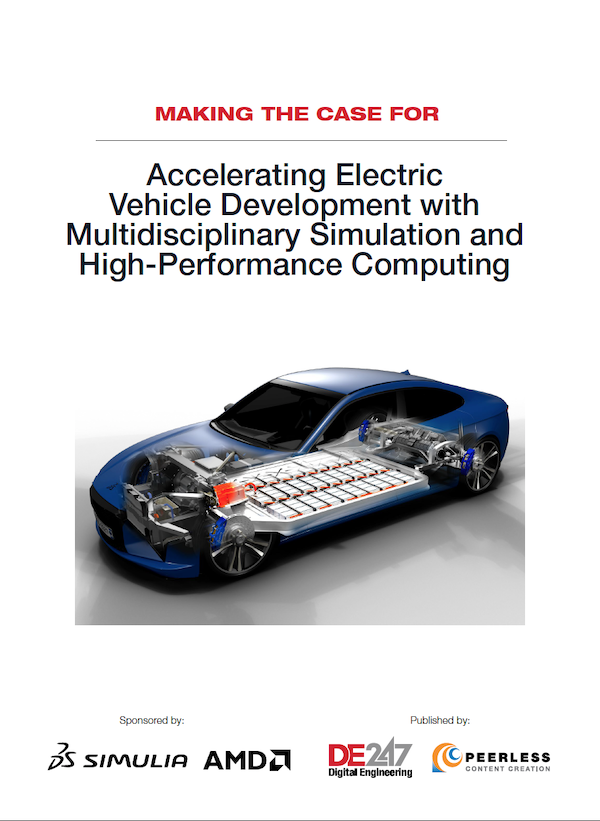
Accelerating Electric Vehicle Development with Multidisciplinary Simulation and High-Performance Computing
In this new Making the Case guide, learn how a unified approach to design and multidisciplinary simulation from Dassault Systèmes, combined with high-performance computing powered by AMD EPYC™ processors, can accelerate EV design.

DE's editors contribute news and new product announcements to Digital Engineering. Press releases may be sent to them via [email protected].
Follow DE
Join over 90,000 engineering professionals who get fresh engineering news as soon as it is published.






About Us · Contact Us · Editorial Team · Advertising · Privacy Policy · Subscriber Services · © 2026 Digital Engineering 24/7 · Peerless Media