Helping design and engineering professionals discover, evaluate and specify technologies and processes that shorten the design cycle and enable success.




Cut Retrieval-Augmented Generation (RAG) Hallucinations by 50%
Most teams hit the same wall with enterprise AI: LLMs that hallucinate, pipelines that don’t scale, and infrastructure that’s harder to design than the models themselves.

What Is Intelligent BOM Management? A Guide to Smarter Product Development
Learn how intelligent Bill of Materials (BOM) management helps teams collaborate, reduce errors, and bring innovative products to market faster with cloud-based PLM tools.
AMD has unveiled the AMD RDNA 4 graphics architecture with the launch of the AMD Radeon RX 9070 XT and RX 9070 graphics cards as a part of the Radeon RX 9000 Series. The new graphics cards feature 16GB of memory and improvements designed for gaming graphics, including re-vamped raytracing accelerators and AI accelerators for ultra-fast performance.
The RX 9000 Series, powered by the new AMD RDNA 4 architecture, offers creators performance and visuals. These graphics cards feature third-generation raytracing technology enabling realistic lighting, shadows, and reflections while integrating a suite of AMD features to maximize hardware utilization. The RX 9000 Series GPUs leverage new second-generation AI accelerators with up to 8x INT8 throughput per AI accelerator (for sparse matrices) to enhance creative applications and run generative AI applications (vs. RDNA 3).
The RX 9000 Series GPUs also implement the newly redesigned AMD Radiance Display Engine & Enhanced Media Engine for broad display support and elevated quality in recording and streaming.
The Radeon RX 9070 Series offers 16GB of GDDR6 memory.
Special features:
Unified AMD RDNA 4 Compute Units—Features up to 64 advanced AMD RDNA 4 compute units
High-Performance Raytracing—With 3rd-generation Raytracing Accelerators, AMD RDNA 4 is able to deliver more raytracing throughput per compute unit compared to the previous generation.
AI Acceleration—2nd-Generation AI Accelerators received several enhancements, allowing AMD RDNA 4 to process advanced AI models faster than what was possible with RDNA 3,4 through a combination of additional math pipelines for AI calculations.
AMD FidelityFX Super Resolution Technology 4 (FSR 4)—AMD’s new ML-powered upscaling technology delivers boosted frames under even demanding workloads.
AI-Enhanced AMD Software: Adrenalin Edition Application—A new suite of software and resources designed to deliver an AI user experience with AMD Radeon RX 9070 Series graphics cards.
For more product details, click here.
Sources: Press materials received from the company and additional information gleaned from the company’s website.


AMD, or Advanced Micro Devices, has driven innovation in high-performance computing, graphics and visualization technologies. They develop high-performance computing and visualization products to solve some of the world’s toughest and most…
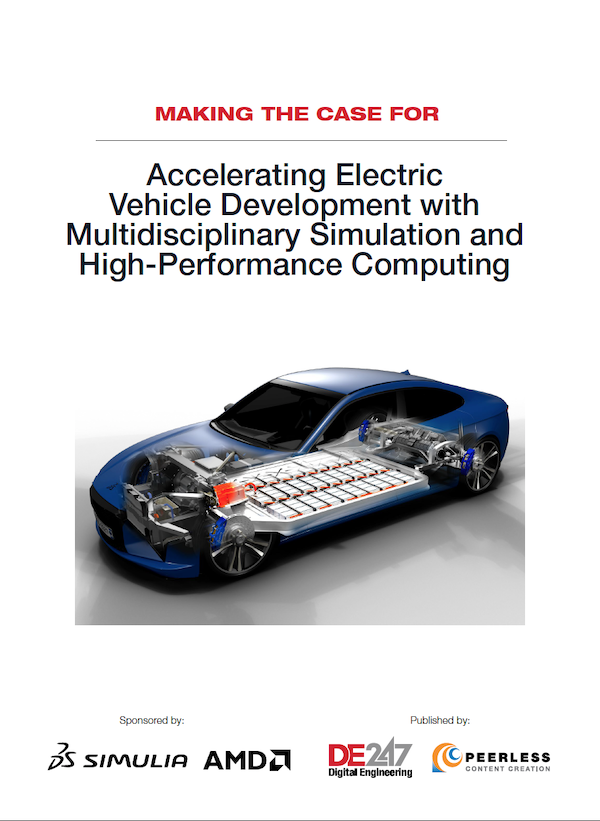
Accelerating Electric Vehicle Development with Multidisciplinary Simulation and High-Performance Computing
In this new Making the Case guide, learn how a unified approach to design and multidisciplinary simulation from Dassault Systèmes, combined with high-performance computing powered by AMD EPYC™ processors, can accelerate EV design.

DE's editors contribute news and new product announcements to Digital Engineering. Press releases may be sent to them via [email protected].
Follow DE
Join over 90,000 engineering professionals who get fresh engineering news as soon as it is published.






About Us · Contact Us · Editorial Team · Advertising · Privacy Policy · Subscriber Services · © 2026 Digital Engineering 24/7 · Peerless Media