Helping design and engineering professionals discover, evaluate and specify technologies and processes that shorten the design cycle and enable success.


Alert!
Digital Engineering ceased publication on July 1, 2026. This website remains available as an archive of engineering content.
For inquiries or information, please email [email protected].

Digital Engineering April 2026
In the latest issue of Digital Engineering, we take a look at the latest innovations in design for additive manufacturing, including the use of natural language inputs, social media cosplayers, and AI integration. The issue also includes a feature…

January Special Focus Issue: Design for Additive
In this Special Focus Issue of Digital Engineering, learn about the latest advancements in design for additive manufacturing, including new software tools, additive in automotive, custom medical devices, and more.
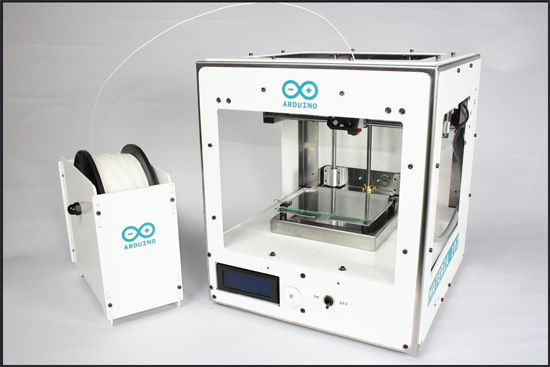
The latest company to enter the market is Arduino, a company mainly known for its open-source, single-board microcontroller. Arduino’s new 3D printer is named (and get ready for the Final Fantasy jokes to fly) the Materia 101, and it will officially launch at Maker Faire Rome. Arduino received help in developing the new AM system from Sharebot.
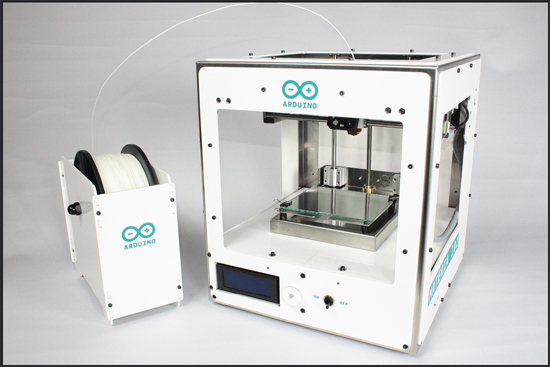 Arduino's entry into 3D printing is the Materia 101. Courtesy of Arduino.
The Materia 101 has been designed to be about as affordable as any desktop system can hope to be, with prices of €600 ($800) for a kit or €700 ($1,000) for a fully assembled system. While $1,000 may not seem cheap, ask any number of Kickstarter companies how realistic it is to produce a working 3D printer for less than that amount (hint: not very).
Arduino’s system is a fused deposition modeling (FDM) clone that looks a fair amount like a few of the older MakerBot models. It doesn’t appear to require its own proprietary material cartridge, which may help users save a few bucks down the road. PLA is the only supported material thus far, but the company has been testing its system with Cristal Flex, PLA thermosense, and thermoplastic polyuretane as well.
Tech specs are as follows:
Obviously that isn’t the largest build area around, nor does the system launch with a laundry list of supported materials. What Arduino has going for it is the hacker/maker community, and its open-source ethos. With the maker community in search of new heroes to support, the Materia 101 will no doubt find its way to a number of home workshops and maker spaces.
Below you’ll find a video about Arduino.
Source: Arduino


John Newman is a Digital Engineering contributor who focuses on 3D printing. Contact him via [email protected] and read his posts on Rapid Ready Technology.
Follow DE






About Us · Contact Us · Editorial Team · Advertising · Privacy Policy · Subscriber Services · © 2026 Digital Engineering 24/7 · Peerless Media