Helping design and engineering professionals discover, evaluate and specify technologies and processes that shorten the design cycle and enable success.



Digital Engineering April 2026
In the latest issue of Digital Engineering, we take a look at the latest innovations in design for additive manufacturing, including the use of natural language inputs, social media cosplayers, and AI integration. The issue also includes a feature…

January Special Focus Issue: Design for Additive
In this Special Focus Issue of Digital Engineering, learn about the latest advancements in design for additive manufacturing, including new software tools, additive in automotive, custom medical devices, and more.
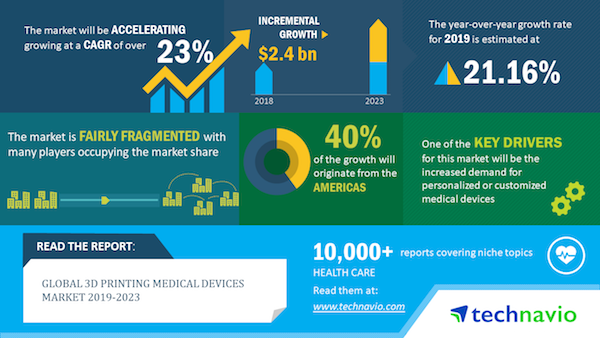
The global market for 3D printing of medical devices will have a compound annual growth rate (CAGR) of more than 23% through 2023, according to research firm Technavio.
Technical advancements have helped spur adoption of 3D printing in the medical industry. Those advancements include increased volume capacities for the printers, as well as greater efficiency and higher levels of precision.
Medical professionals are also adopting 3D printing technology in the clinical setting, using the devices to print detailed models of human organs for surgical planning, as well as creating custom-designed implants and prostheses.
According to Technavio:
“Pre-surgical planning of certain procedures such as shoulder arthroplasty can be performed much more effectively using 3D images than 2D images and complex spinal deformities can also be studied better using a 3D anatomical model. Also, in radiology, 3D anatomic models are useful for explaining imaging findings, such as breast calcifications or fetal anomalies, which is difficult for many patients to conceptualize.”
Materialise and its partners, including Stratasys and Ultimaker, have had their technology approved by the FDA for use in these types of modeling applications.
The Americas currently hold the largest shared of the medical 3D printing market at 46%. According to the report, that can be attributed to increased demand for personalized or customized medical devices and rising adoption of 3D printing technology by medical professionals in those countries.
The orthopedic and spinal segment was the largest in 2018, followed by dental applications and hearing aids.
You can purchase the report, “Global 3D Printing Medical Devices Market – Size, Growth, Trends, and Forecast for 2019 – 2028,” here.
Source: Technavio


Brian Albright is the editorial director of Digital Engineering.
Contact him at [email protected].

Join over 90,000 engineering professionals who get fresh engineering news as soon as it is published.






About Us · Contact Us · Editorial Team · Advertising · Privacy Policy · Subscriber Services · © 2026 Digital Engineering 24/7 · Peerless Media