Helping design and engineering professionals discover, evaluate and specify technologies and processes that shorten the design cycle and enable success.



Digital Engineering April 2026
In the latest issue of Digital Engineering, we take a look at the latest innovations in design for additive manufacturing, including the use of natural language inputs, social media cosplayers, and AI integration. The issue also includes a feature…

January Special Focus Issue: Design for Additive
In this Special Focus Issue of Digital Engineering, learn about the latest advancements in design for additive manufacturing, including new software tools, additive in automotive, custom medical devices, and more.
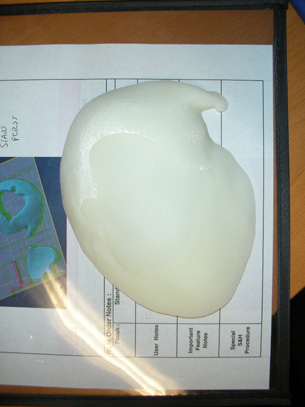 Actual cranial prototype photo showing undamaged host-bone with replacement piece in place (perfect fit). |
Kelyniam Global, Inc. (Little Rock, ARK) announced that the Bio-CADCAM cranial implant process their medical suppliers use is in final stages of FDA approval.
An advanced engineering and rapid prototyping company, Kelyniam Global has been contracted by, and worked closely with a major medical supplier in the development of artificial replacement implants for the human skull. The master models used in the production of these custom cranial implants are created by Kelyniam’s Engineering Division. Kelyniam’s final implant is said to be of a higher tolerance, greater comfort and has a shorter recovery time than others designed using traditional techniques due to its “near-exact fit.”
Kelyniam uses a combination of traditional medical technology and cutting edge Bio-CAD/CAM technology, to be able to create an implant master model that is a near-perfect fit to a damaged area of the skull (accurate within 10-20/1000 inch). By importing CT Scanned data into a computer, technicians are able to recreate a 3 dimensional CAD model of the patient’s skull. The CAD data is then used by Kelyniam’s engineers to make a highly accurate model that is used by the medical supplier to create a biocompatible implant to replace the damaged area. All in all, including the time it takes to get the scans from the doctors, a patient can have an implant that is a near-perfect replacement of the damaged area within a matter of days.
It is expected that FDA approval of this process will increase the opportunities to use these applications for implants for other areas of the human body.
For further information, visit Kelyniam.
Sources: Press materials received from the company and additional information gleaned from the company’s website.


DE's editors contribute news and new product announcements to Digital Engineering. Press releases may be sent to them via [email protected].
Follow DE
Join over 90,000 engineering professionals who get fresh engineering news as soon as it is published.






About Us · Contact Us · Editorial Team · Advertising · Privacy Policy · Subscriber Services · © 2026 Digital Engineering 24/7 · Peerless Media