Helping design and engineering professionals discover, evaluate and specify technologies and processes that shorten the design cycle and enable success.


Alert!
Digital Engineering ceased publication on July 1, 2026. This website remains available as an archive of engineering content.
For inquiries or information, please email [email protected].

May 2026 Special Focus: Artificial Intelligence in Design and Simulation
In this Special Focus Issue, learn about the latest developments in the integration of artificial intelligence into engineering workflows.

April 2026 Special Focus Issue: Generative Design
In this Special Focus Issue, Digital Engineering takes a look at how generative design solutions can be used across different types of design problems and with a variety of manufacturing approaches to accelerate design space exploration, and…
The latest version of the Theorem-XR experience suite and Visualization Pipeline are now available from Theorem Solutions for download with next-generation productivity-enhancing features to support the XR user.
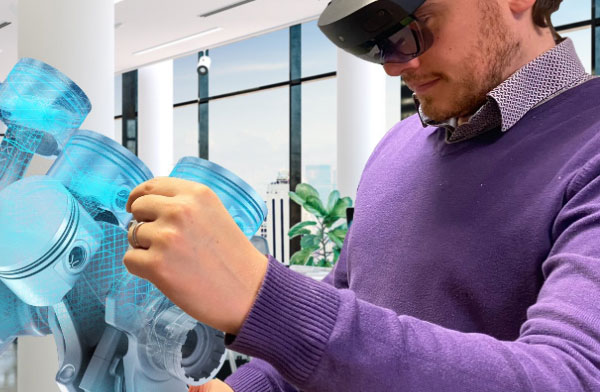
This latest release sees the Theorem-XR portfolio offering support for Microsoft HoloLens 2 and to complement this, support for Microsoft Azure Remote Rendering (ARR) technology, enabling high-performance, large-scale data streaming to your HoloLens 2 device. Theorem Solutions is also a member of the Microsoft Mixed Reality Partner Program, enabling the ability to build and deploy these industry solutions that combine its 25-plus years of visualization experience working with CAD.
This release includes the following new features for the Visualization Pipeline:
An overview of these features can be found on the website.
If you aren’t aware of Theorem-XR or what it can do, it enables users to visualize your 3D CAD and PLM assets in context and at full scale, using augmented, mixed and virtual reality technologies on the device of your choice. Theorem-XR is data and device neutral.
Out of the box Theorem-XR offers ‘standard’ engineering-based use case experiences that work collaboratively, enabling remote teams and home-based staff to join and work in an immersive multi-user environment, from anywhere, all that is needed is an internet connection. Even desktop users can join a collaborative session.
Experiences include:
The experiences are underpinned by the Visualization Pipeline, which provides a fully automated process that takes 3D data assets directly into Theorem-XR, or for the creation of Unity or Unreal assets for use in internally developed XR solutions. Using the Visualization Pipeline to prepare and optimize CAD data removes the difficulties that can be encountered when trying to get 3D data into XR, and can be done from within the CAD system by simply using the ‘save as’ command, ‘drag and drop’ your data on to the server, or used as part of a PLM integration.
Using Theorem-XR to undertake everyday engineering tasks allows users to visualize your 3D CAD data at full scale and in context, rather than from the confines of a 2D computer screen. Using the latest XR technologies help to reduce costs, improve product quality and support the faster development of products and manufacturing processes across the enterprise by bridging the gap between the digital and the physical.
Sources: Press materials received from the company and additional information gleaned from the company’s website.


Theorem Solutions enables engineering and manufacturing companies to extend the use of their 3D design data in the latest innovative and emerging technologies. Providing specialist tools for CAD Translation, Interactive Documentation and Full…
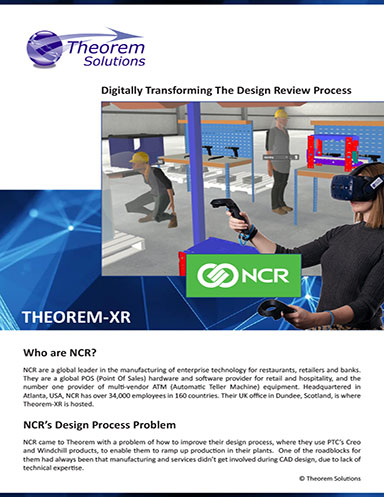
Digitally Transforming the Design Review Process
In only a short time, ATM manufacturer NCR (National Cash Registers) have revolutionized their design review and prototyping processes with the help of Theorem-XR.

DE's editors contribute news and new product announcements to Digital Engineering. Press releases may be sent to them via [email protected].
Follow DE






About Us · Contact Us · Editorial Team · Advertising · Privacy Policy · Subscriber Services · © 2026 Digital Engineering 24/7 · Peerless Media