Helping design and engineering professionals discover, evaluate and specify technologies and processes that shorten the design cycle and enable success.


Alert!
Digital Engineering ceased publication on July 1, 2026. This website remains available as an archive of engineering content.
For inquiries or information, please email [email protected].


Sponsored
Artificial Intelligence for Design and Engineering Workflows
In this white paper, learn how artificial intelligence and machine learning can improve design and simulation.
Technology Focus: Designing for Optimization & Simulation
Simulation is pervasive, with people from different departments and backgrounds discovering new ways to put it to use, in all of its varied forms.
For many in the consumer tech sector, CES (Consumer Electronics Show) in January is the annual event that kicks off the year. This year, it attracted 148,000 attendees from around the world, filling the Las Vegas strip with tech enthusiasts.
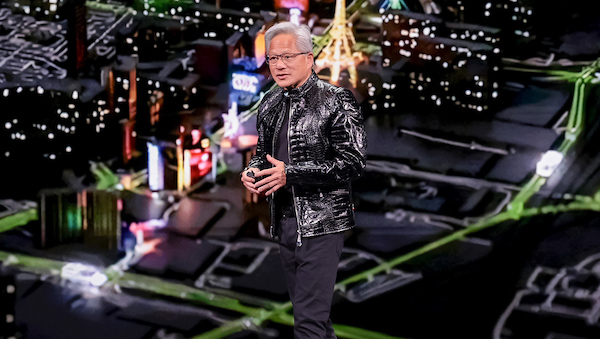
In his trademark leather jacket, NVIDIA CEO Jensen Huang opened the event with a keynote at the Fontainebleau Las Vegas. "Computing has been fundamentally reshaped as a result of accelerated computing, as a result of artificial intelligence," he said. "Hundreds of billions of dollars, a couple hundred billion dollars in VC funding each year is going into modernizing and inventing this new world ... A hundred trillion dollars of industry, several percent of which is R&D budget, is shifting over to artificial intelligence."
Huang put the spotlight on two areas: physical AI, or AI that understands and obeys the laws of physics; and the open-source movement in AI. "AI is going to proliferate everywhere when open source and innovation across every single company and every industry around the world is activated. Open models really took off last year. In fact, last year we saw the advance of DeepSeek R1, the first open model that's a reasoning system," he noted.
Most early AI programs simply operate as data retrieval tools, with a natural language interface. But things are about to change. "The reasoning capability of agents opened doors to all of these different applications. We no longer have to train an AI model to know everything on day one, just as we don't have to know everything on day one. That we should be able to in every circumstance reason about how to solve that problem,” Huang said.
At the event, Huang unveiled Rubin, the company’s extreme codesign, six-chip AI platform, and the successor to the NVIDIA Blackwell architecture. NVIDIA also announced that its NVIDIA BlueField®-4 data processor (part of the full-stack NVIDIA BlueField platform) powers the NVIDIA Inference Context Memory Storage Platform (CMS), a new class of AI-native storage infrastructure. Dell Technologies is collaborating with NVIDIA on CMS solutions, which you can read about here.
At the NVIDIA booth, the company showed off its DGX Spark and DGX Station deskside AI supercomputers. The DGX Spark platform powers the new Dell Technologies Dell Pro Max with GB10 computer and the upcoming Dell Pro Max with GB300.
At the event, NVIDIA announced Alpamayo, a family of open-source AI models and tools for autonomous vehicle (AV) development. According to the announcement, "The Alpamayo family introduces chain-of-thought, reasoning-based vision language action (VLA) models that bring human-like thinking to AV decision making."
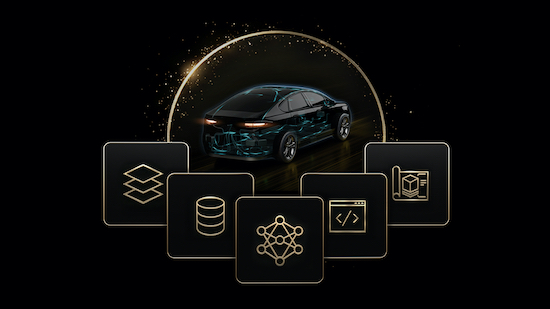
NVIDIA launches Alpamayo, a set of Physical AI models for autonomous vehicle developers. Image courtesy of NVIDIA.
Haung said, “The ChatGPT moment for physical AI is here -- when machines begin to understand, reason, and act in the real world.”
NVIDIA describes the offering as "large-scale teacher models that developers can fine-tune and distill into the backbones of their complete AV stacks." The Alpamayo sits on three pillars: open models, simulation frameworks, and datasets.
Open Models: Alpamayo 1 is a chain-of-thought reasoning VLA model designed for the AV research community, delivered via the Hugging Face open-source portal. It uses video input to generate trajectories alongside reasoning traces, showing the logic behind each decision.
Simulation Frameworks: AlpaSim is an open-source simulation framework for high-fidelity AV development, delivered via GitHub. It includes sensor modeling, configurable traffic dynamics, and scalable closed-loop testing environments.
Datasets: Through Hugging Face, NVIDIA is offering an open dataset for AV that contains 1,700+ hours of driving data collected across a wide range of geographies and conditions, covering rare and complex real-world edge cases.
“The launch of the Alpamayo portfolio represents a major leap forward for the research community,” said Wei Zhan, co-director of Berkeley DeepDrive. “NVIDIA’s decision to make this openly available is transformative as its access and capabilities will enable us to train at unprecedented scale — giving us the flexibility and resources needed to push autonomous driving into the mainstream.”
Hardware maker Dell offers enterprise AI servers in partnership with NVIDIA, under the Dell AI Factory family. They deliver GPU-accelerated computing, data storage, data management, and networking features. The lineup includes the air-cooled Dell PowerEdge XE9780 and XE9785 servers, and liquid-cooled Dell PowerEdge XE9780L and XE9785L servers. The Dell PowerEdge XE7740 and XE7745 server is available with NVIDIA RTX Pro 6000 Blackwell Server Edition GPUs.
Huang also appeared on stage alongside Siemens CEO Roland Busch to discuss the partnership between NVIDIA and Siemens. The press announcement from NVIDIA described the latest move as "a significant expansion of their strategic partnership to bring artificial intelligence into the real world."
“Together, we are building the Industrial AI operating system -- redefining how the physical world is designed, built and run -- to scale AI and create real-world impact,” said Busch.
The companies plan to develop industrial and physical AI solutions to inject AI-driven features into the industry and industrial workflow -- Siemens' domain for industrial digital twins. To realize this, NVIDIA will provide AI infrastructure, simulation libraries, models, frameworks, and blueprints.
NVIDIA's partnership with Siemens took roots in 2022, when Siemens decided to integrate NVIDIA Omnivere-powered visualization features and digital twin functions into the Siemens Xcelerator portfolio. Siemens also plans to complete GPU acceleration across its entire simulation portfolio to support NVIDIA CUDA-X libraries and physics models.
You can read more about NVIDIA’s announcements at CES in this blog. You can read about more Dell CES announcements here.


Brian Albright is the editorial director of Digital Engineering.
Contact him at [email protected].






About Us · Contact Us · Editorial Team · Advertising · Privacy Policy · Subscriber Services · © 2026 Digital Engineering 24/7 · Peerless Media