Helping design and engineering professionals discover, evaluate and specify technologies and processes that shorten the design cycle and enable success.


Alert!
Digital Engineering ceased publication on July 1, 2026. This website remains available as an archive of engineering content.
For inquiries or information, please email [email protected].
Sponsored

May 2026 Special Focus: Artificial Intelligence in Design and Simulation
In this Special Focus Issue, learn about the latest developments in the integration of artificial intelligence into engineering workflows.

Design & Simulation Software Guide 2025
In this Special Issue, Digital Engineering presents its second annual guide to design and simulation software vendors.
Dear Desktop Engineering Reader:
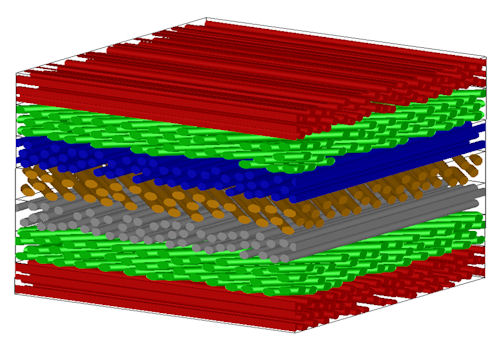 These poor saps just wanted a beer but they sat down next to me. One of them asked the other if he knew anything about wood-plastic decking materials. When he said no, I nose in and start gibbering on about the wonders of composite materials. How they are used in things like planes, cars, and my caps. That modeling the materials is fascinating. They were gravely disquieted. I should have been embarrassed, but such rants seem to be one of my traits. Still, it was his fault for bringing it up. Composites really are wonders, and your ability to work with them just got a lot more practical.
At the end of September, MSC Software acquired e-Xstream engineering, a developer of advanced materials simulation tools. You likely know e-Xstream from its Digimat-branded product line and its Digimat interfaces that work with most FEA structural analysis codes, including Abaqus, ANSYS, LS-Dyna, and MSC’s Nastran and Marc.
Highlights of the Digimat line include Micross, which provides capabilities to perform the test procedures for the modeling of honeycomb core sandwich structures, and Digimat-MAP 2D/3D mapping software, which is used to transfer fiber orientation, residual stresses, and temperature from the injection molding mesh to your structural FEA mesh. There’s also Digimat-MF mean-field homogenization software for predicting the nonlinear behavior of multiphase composite materials, Digimat-FE for generating an RVE (representative volume element) for a variety of material microstructures, and the Digimat-MX composite materials database.
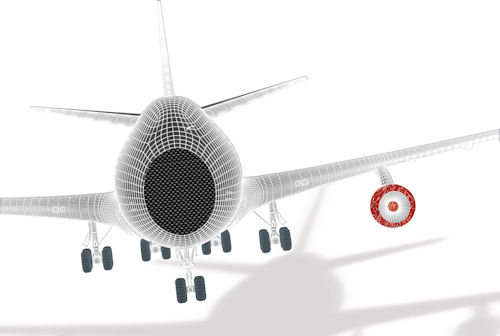 So, what does this acquisition mean for you? Well, foremost, Digimat tools bring to the MSC engineering toolbox nonlinear micro-mechanics, which means you can model a vast range of materials and physics while taking into account their manufacturing processes as you model. Let me quickly add that MSC says it plans no change to current Digimat support of software tools from other vendors, so if you are already using Digimat-CAE with Moldex3D, SigmaSoft, or something, you can relax.
But what it really means is you can have the ability to explore, test, validate, and ultimately incorporate advanced materials into your designs. That is, working with these materials becomes practical on both the what-if level and build specification level. The benefits of leveraging the materials, of course, range from reduced product weight to faster development time and from fewer materials to innovative structures previously beyond your capacity.
That’s good stuff sure to intrigue you, and probably your VPs of engineering and finance as well. You can learn more about MSC Software and the Digimat material and structure modeling systems from the link over there.
Thanks, Pal. – Lockwood
Anthony J. Lockwood
Editor at Large, Desktop Engineering


Anthony J. Lockwood is Digital Engineering's founding editor. He is now retired. Contact him via [email protected].
Follow DE






About Us · Contact Us · Editorial Team · Advertising · Privacy Policy · Subscriber Services · © 2026 Digital Engineering 24/7 · Peerless Media