Helping design and engineering professionals discover, evaluate and specify technologies and processes that shorten the design cycle and enable success.


Alert!
Digital Engineering ceased publication on July 1, 2026. This website remains available as an archive of engineering content.
For inquiries or information, please email [email protected].

May 2026 Special Focus: Artificial Intelligence in Design and Simulation
In this Special Focus Issue, learn about the latest developments in the integration of artificial intelligence into engineering workflows.

Design & Simulation Software Guide 2025
In this Special Issue, Digital Engineering presents its second annual guide to design and simulation software vendors.
Coreform LLC, developer of commercial spline-based simulation software, announces its receipt of a substantial government grant to explore a new method for simulating parts for 3D printed manufacturing.
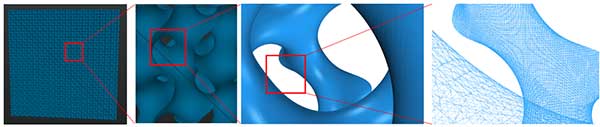
Lattice structure patterns are becoming attractive to auto and airplane engineers because of their high strength-to-weight ratios. However, until now, these structures have been too complex for computers to be able to analyze them for things like stress reactions or collapse responses, the company says.
“Until now,” says Coreform CEO Matthew Sederberg, “without the ability to test parts via computer simulation, 3D printing of lattice structure in manufacturing has been largely relegated to prototypes and non-critical parts.”
Utah-based Coreform has developed an innovative technology that might solve this problem. Their flexible isogeometric analysis (Flex IGA) approach to simulation can handle the complexities of lattice structures with a lower computational burden, the company reports. In recognition of this technology’s potential, Coreform LLC has won a highly competitive government grant that will allow them to begin developing next-generation software for simulation of the lattice structures used in 3D printing. This grant, offered through the Federal Small Business Innovation Research (SBIR) program, is designed to support small businesses in pursuing innovative solutions to technological problems.
“We’re proud of Flex IGA, and proud that the SBIR program agrees that this is a valuable project to pursue,” says Coreform director of Product Management Gregory Vernon. “We think this is absolutely going to change the game for deployment of 3D printed parts.”
3D printing allows manufacturers to print parts such as car bumpers with complex lattice microstructures that save material and weight. Coreform’s Flex IGA process may make it possible to subdivide, or “mesh”, these complex microstructures with a minimum of time and expense. They anticipate using the SBIR grant to computer simulate a 3D-printed lattice structure that is more than ten times larger than any lattice structure that can be simulated today. If successful, Coreform’s technology will be key to making 3D printing a reality for manufacturers.
Sources: Press materials received from the company and additional information gleaned from the company’s website.


DE's editors contribute news and new product announcements to Digital Engineering. Press releases may be sent to them via [email protected].
Follow DE






About Us · Contact Us · Editorial Team · Advertising · Privacy Policy · Subscriber Services · © 2026 Digital Engineering 24/7 · Peerless Media