Helping design and engineering professionals discover, evaluate and specify technologies and processes that shorten the design cycle and enable success.


Alert!
Digital Engineering ceased publication on July 1, 2026. This website remains available as an archive of engineering content.
For inquiries or information, please email [email protected].

Digital Engineering April 2026
In the latest issue of Digital Engineering, we take a look at the latest innovations in design for additive manufacturing, including the use of natural language inputs, social media cosplayers, and AI integration. The issue also includes a feature…

January Special Focus Issue: Design for Additive
In this Special Focus Issue of Digital Engineering, learn about the latest advancements in design for additive manufacturing, including new software tools, additive in automotive, custom medical devices, and more.
Researchers at Cornell University have embraced the challenges of 3D printed electronics and recently managed to produce a speaker built entirely using AM. A speaker is a fairly simple piece of technology, compared with more advanced electronic devices, and the challenge in designing one that could be built using AM required material engineering expertise to complement the 3D design.
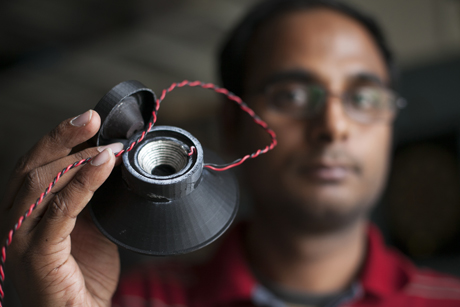
Speakers generally consist of three parts: a casing, a conductive coil, and a magnet. Anyone even vaguely familiar with AM will realize that plastic casing production is rarely a problem for 3D printing. More challenging was mixing up a printable conductive material and printable magnet. Researchers settled on silver ink for the conductive coil, and Samanvaya Srivastava, graduate student in chemical and biomolecular engineering, developed a blend of strontium ferrite that would work with an AM system and produce a magnetic field.
Mechanical engineering graduate students Apoorva Kiran and Robert MacCurdy were assisted with the project by Hod Lipson, associate professor of mechanical and aerospace engineering. The parts for the speaker were printed on a fab@home AM system, which was originally developed at Cornell. Fab@home printers were designed to be research AM systems, with the capability of printing in multiple materials (though not at the same time).
Lipson is encouraging his students to move their AM research beyond parts production and into complex, end-use products like the speaker. While it will be some time before a home 3D printer is capable of printing in multiple materials without requiring the assistance of a materials expert, Lipson is certain it is possible. Printed electronic devices could provide the impetus (and financial backing) to further research.
“It opens up a whole new space that makes the old look primitive,” said Lipson.
Below you’ll find a short video about Cornell’s new sound system.
Source: Cornell University


John Newman is a Digital Engineering contributor who focuses on 3D printing. Contact him via [email protected] and read his posts on Rapid Ready Technology.
Follow DE






About Us · Contact Us · Editorial Team · Advertising · Privacy Policy · Subscriber Services · © 2026 Digital Engineering 24/7 · Peerless Media