Helping design and engineering professionals discover, evaluate and specify technologies and processes that shorten the design cycle and enable success.



Cut Retrieval-Augmented Generation (RAG) Hallucinations by 50%
Most teams hit the same wall with enterprise AI: LLMs that hallucinate, pipelines that don’t scale, and infrastructure that’s harder to design than the models themselves.

What Is Intelligent BOM Management? A Guide to Smarter Product Development
Learn how intelligent Bill of Materials (BOM) management helps teams collaborate, reduce errors, and bring innovative products to market faster with cloud-based PLM tools.
 |
Cubix Corporation has begun shipping its secure, high-performance blade workstation/virtual PC solutions for 3D CAD/MCAD, CAE, and 3D GIS customers who need to provide users with high-performance 3D graphics processing, but also need to meet corporate CIO/CTO directives for virtual PCs, thin-clients, and other green technology initiatives. Cubix’s Secure Visualization Blade technology has the centralized application and hardware management benefits of virtual PC technology, but without the graphics performance penalties and limited display support associated with thin-client, PC-over-IP, and virtual PC deployments.
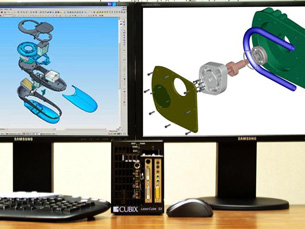
Providing transparent performance when compared with equivalent tower PC workstation configurations, Cubix Secure Visualization Blades (SVBs) enable 3D CAD/MCAD operators to reduce PC footprint, noise, and heat issues for both commercial and government 3D graphics markets. Cubix achieved its goal of providing 3D graphics professionals with an alternative to competing thin-client/blade workstation solutions by developing a high-bandwidth interface link between host blade PC and the remote operator’s desktop.
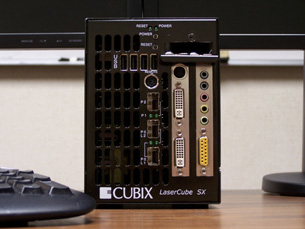
“Instead of processing KVM signals into rigid IP packets, or using hi-loss compression algorithms, Cubix decided to use fiber optics to connect the remote 3D graphics operators to their dedicated blade PC”, says Eric Carlson, Cubix Business Development Manager. Cubix SVB clients, called LaserCubes, are designed for use up to 300 meters distant from the blade motherboard .
 |
“By utilizing fiber optics’ exceptional bandwidth, Cubix can integrate discrete, high-performance NVIDIA or ATI graphics cards, including the latest full-length, double-wide ATI FireGL and NVIDIA Quadro FX products, into the remote LaserCube ‘thin’ client, without need for an additional CPU, or use of a low-powered mobile GPU or IGP at the client.”
The result, according to Carlson , is a secure, high-performance PC workstation experience for the 3D CAD / MCAD operator where dual-link DVI graphics performance at the remote desktop can exceed 200 frames per second.
The blade portion of the SVB, called LaserBlade, ships with the latest Intel chipsets, with motherboards featuring Core 2 Quad, Core i7, and Quad Core Xeon processors. PCIe, PCI-X, and PCI expansion slots are available options for use with industry-standard I/O controllers. The entire system can be remotely managed with a single CubixVision remote manager.
For more information, visit Cubix Corporation.


DE's editors contribute news and new product announcements to Digital Engineering. Press releases may be sent to them via [email protected].
Follow DE
Join over 90,000 engineering professionals who get fresh engineering news as soon as it is published.






About Us · Contact Us · Editorial Team · Advertising · Privacy Policy · Subscriber Services · © 2026 Digital Engineering 24/7 · Peerless Media