Helping design and engineering professionals discover, evaluate and specify technologies and processes that shorten the design cycle and enable success.



May 2026 Special Focus: Artificial Intelligence in Design and Simulation
In this Special Focus Issue, learn about the latest developments in the integration of artificial intelligence into engineering workflows.

Design & Simulation Software Guide 2025
In this Special Issue, Digital Engineering presents its second annual guide to design and simulation software vendors.
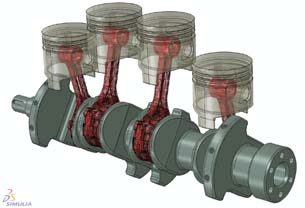 This model illustrates an automotive engine mechanism model with the conrods modeled as substructures for improved computational efficiency. |
Dassault Systèmes has announced the availability of Abaqus 6.10 Extended Functionality (6.10-EF), a unified finite element analysis (FEA) and multiphysics product suite from SIMULIA, the Dassault Systémes brand for simulation.
Abaqus 6.10-EF delivers a number of enhancements for modeling, visualization, contact, mechanics and performance. These improvements are designed to help customers reduce development time and costs, while increasing the efficiency of the product development process through simulations of real-world product and material behavior.
Among the modeling and visualization enhancements in 6.10-EF is dramatically improved support for substructure modeling capabilities, according to the company. Abaqus users can now more easily create a substructure of a distinct region in their product, import it into an assembly, recover the results during an analysis, and reuse the substructures in future models.
“The rearview mirror systems we supply to the medium- and heavy-duty truck manufacturers contain a number common internal sub-assemblies, such as actuators, that are used in many different mirror systems,” says Dr. Rolf de Swardt, chief engineer and FEA specialist at Lang Mekra North America. “The new substructure support capability in Abaqus 6.10-EF allows us to develop very detailed FE models of these components, and then ‘plug’ them into new system models, not only saving us time in constructing the models, but also shortening runtime of the large eigenvalue analyses we typically perform to ensure the mirrors do not vibrate excessively.”
Abaqus 6.10-EF also provides new contact and mechanics capabilities designed to improve the efficiency and accuracy of simulating real-world performance of designs, including fluid leakage between 3D bodies in contact. For example, uneven pressure applied to a syringe plunger during use can result in fluid leakage between the rubber seal and barrel. Support for 3D pressure penetration loading can now be used with any contact formulation, allowing for higher-fidelity simulation results.
"The goal of our research is to provide customers with the latest data related to polymer materials, rubber compounds and polyurethanes. We are pleased that Abaqus 6.10-EF provides support for pressure penetration loading in 3D models,” says Dr. Oliver Haeusler, head of the CAE department at Freudenberg Forschungsdienste KG. “This feature will enable our team to perform more accurate analyses of membranes or pneumatic seals with applied 3D loads."
The latest release also expands the capabilities of the Extended Finite Element Method (XFEM) in Abaqus, allowing users to predict crack growth due to low-cycle fatigue, such as with thermal analysis of the heating and cooling phase that occurs in an engine exhaust manifold. The company says this capability can also be used to accurately predict the durability and damage tolerance of composite structures with complex failure mechanisms.
"The implementation of the Extended Finite Element Method (XFEM) within Abaqus provides us with a means to calculate stress intensity factors without explicitly modelling the defect,” says Ian Symington, senior consultant at Serco, Technical Consulting Services. “This approach has the potential to save significant time during the mesh generation phase and reduce the prolonged effort usually associated with undertaking fatigue crack growth assessments."
Abaqus 6.10-EF also provides performance enhancements, including a new scalable, parallel execution capability within the AMS eigensolver, which accelerates frequency extraction analyses required to study noise, vibration, and harshness (NVH) behavior in vehicles.
For more information, visit Dassault Systèmes’ SIMULIA site.
Sources: Press materials received from the company and additional information gleaned from the company's website.


DE's editors contribute news and new product announcements to Digital Engineering. Press releases may be sent to them via [email protected].
Follow DE
Join over 90,000 engineering professionals who get fresh engineering news as soon as it is published.






About Us · Contact Us · Editorial Team · Advertising · Privacy Policy · Subscriber Services · © 2026 Digital Engineering 24/7 · Peerless Media