Helping design and engineering professionals discover, evaluate and specify technologies and processes that shorten the design cycle and enable success.



May 2026 Special Focus: Artificial Intelligence in Design and Simulation
In this Special Focus Issue, learn about the latest developments in the integration of artificial intelligence into engineering workflows.

April 2026 Special Focus Issue: Generative Design
In this Special Focus Issue, Digital Engineering takes a look at how generative design solutions can be used across different types of design problems and with a variety of manufacturing approaches to accelerate design space exploration, and…
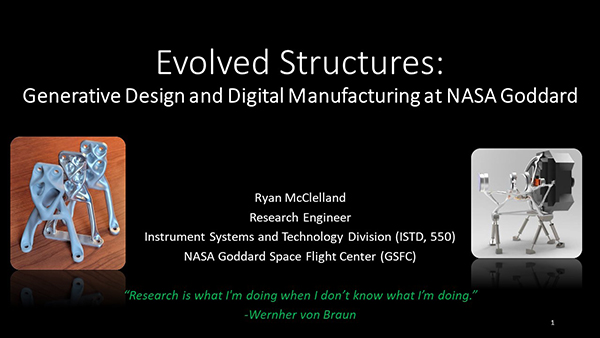
In the upcoming DE Design & Simulation Summit: Additive Manufacturing Track, NASA Goddard Space Flight Center's Research Engineer Ryan McClelland will discuss his development of an AM-printed part for NASA EXCITE, an infrared telescope to observe exoplanets. McClelland uses a combination of generative design (GD) software and additive manufacturing (AM) to produce the one-of-a-kind bracket. He also made different versions of the same part using traditional machining. In his talk he will discuss the differences between human-engineered designs and the surprising twist (literally) the GD software uses to handle the expected load, and the unexpected beauty in AI-derived design. McClelland's work is part of NASA Goddard’s Evolved Structures process.
"Currently CNC is the best fabrication technique for most aerospace parts. However, AM will unlock new potentials as the tools mature," he observed. While the current AM parts are limited in size and scale, he foresees making larger, greater bone-like structures in the future, bringing spacecraft lightweighting to new height.
McClelland identifies GD and digital manufacturing as the key enablers of advancement. In his experience, applying these technologies to spaceflight structures resulted in 2x-4x improvements in stiffness/mass and 5x-10x reduction in development time and cost.
McClelland also shared his findings in a previous DE article, titled "Meet Your New Design Consultant: Generative Design" (April 2022).


Kenneth Wong is Digital Engineering's resident blogger and senior editor. Email him at [email protected] or share your thoughts or suggestions at digitaleng.news/facebook.
Follow DE
Join over 90,000 engineering professionals who get fresh engineering news as soon as it is published.






About Us · Contact Us · Editorial Team · Advertising · Privacy Policy · Subscriber Services · © 2026 Digital Engineering 24/7 · Peerless Media