Helping design and engineering professionals discover, evaluate and specify technologies and processes that shorten the design cycle and enable success.


Alert!
Digital Engineering ceased publication on July 1, 2026. This website remains available as an archive of engineering content.
For inquiries or information, please email [email protected].
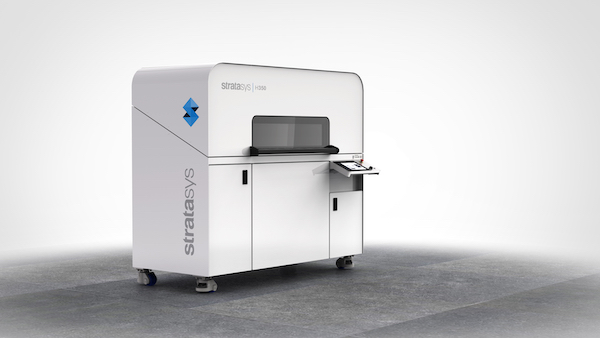
With all signs pointing to the accelerated use of 3D printing technologies for production-scale manufacturing, Stratasys is bolstering its offerings in this class, starting with the release of the first printer powered by its new powder-based SAF technology and following up with the announcement of GrabCAD Additive Manufacturing Platform, an enterprise-ready software stack for managing production-scale output.
Closing its acquisition of Xaar 3D Ltd. (it previously owned a 45% stake), Stratasys has released the first printer based on Selective Absorption Fusion (SAF), what it claims is a uniquely different powder bed fusion (PBF) technology aimed squarely at the production of plastic parts. SAF is what Stratasys calls an industrial-grade technology; it remedies the shortcomings of existing 3D printing solutions, which struggle to achieve the consistency and cost containment demanded for production-grade use cases. Most PBF solutions also rely on the thermal energy of a laser to fuse every single area on the powder bed, which means more complex parts and higher production quantities can take a significant time to output.
SAF, now embedded in Stratasys’ H350 printer, takes a different approach to PBF printing, leveraging industrial print heads combined with a new methodology for powder management. With the SAF approach, Piezo-electric print heads use print fluid to serve as an efficient coolant and to maintain nozzle health, allowing them to withstand high temperature environments. The printer’s powder management technology ensures the requisite powder is always deposited across the entire print bed, preventing thin areas that can lead to overheating. It also recirculates any overflow powder directly back into the feed—a process that reduces powder aging, which can impact the polymer’s mechanical and thermal properties as well as reduce operational costs. Finally, the printer’s high nesting densities and one-pass print-and-fuse operation are designed to handle higher production throughout, enabling companies to achieve precise production parts at competitive costs.
With the SAF technology, the H350 printers execute key 3D printing steps in the same direction across the print bed to provide a uniform thermal experience, a significant leap over traditional PBF offerings, Stratasys officials say. By doing so, the printer can ensure a high level of part consistency without regard to where parts are placed in the build. In addition, the H350 tackles production control through multiple on-board sensors, which log build data to aid in process traceability while giving customers more granular control over the final output. Materials can be controlled, tracked, and traced, and print settings can be finetuned for different customer needs.
“We have been able to significantly improve thermal management for more consistent and reliable parts while giving customers the production control they need,” said Ronen Cohen, general manager of Xaar 3D Ltd., in a press release. “As part of Stratasys, we will continue to rapidly advance H Series 3D printer development while leveraging Stratasys’ global go-to-market infrastructure and blue-chip customer relationships to enable more customers to benefit from SAF-powered additive manufacturing.”
Stratasys also made headway with production-scale AM on the software front. The new GrabCAD Additive Manufacturing Platform is designed to deliver software-operational capabilities that are required to make 3D printing workflows suitable for production-scale output. The platform can be tapped to manage large numbers of 3D printers that are distributed across multiple locations as well as to track output quality, automate materials management, and integrate within the broader enterprise.
The GrabCAD AM Platform integrates both GrabCAD applications along with those from third-party software partners via the GrabCAD Software Development Kit (SDK). The platform includes:
GrabCAD Print, for simplifying workflows between Design for AM (DfAM) and 3D print preparation;
GrabCAD Shop, SaaS work order management software for simplifying printing workflows, including managing orders in one location and assigning them to networked printers, either Stratasys or otherwise;
GrabCAD Print Manager, a new application for managing fleets of industrial 3D printers, including software licenses and open material partners; and
GrabCAD SDK, a set of APIs and documentation for integrating with enterprise IT and third-party applications.


Every day, our customers find simpler, smarter approaches to stubborn design problemsand greater confidence to confront towering human and technological challenges. Less hindered by the usual constraints, they can imagine, design, iterate and…
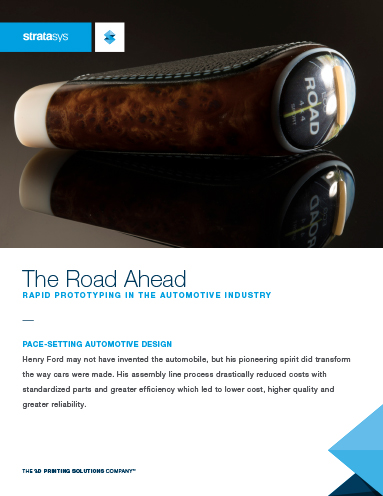
Rapid Prototyping in The Automotive Industry
Henry Ford may not have invented the automobile, but his pioneering spirit did transform the way cars were made. His assembly line process drastically reduced costs with standardized parts and greater efficiency which led to lower cost, higher quality and greater reliability.

Beth Stackpole is a contributing editor to Digital Engineering. Send e-mail about this article to [email protected].
Follow DE
Join over 90,000 engineering professionals who get fresh engineering news as soon as it is published.






About Us · Contact Us · Editorial Team · Advertising · Privacy Policy · Subscriber Services · © 2026 Digital Engineering 24/7 · Peerless Media