Helping design and engineering professionals discover, evaluate and specify technologies and processes that shorten the design cycle and enable success.


Alert!
Digital Engineering ceased publication on July 1, 2026. This website remains available as an archive of engineering content.
For inquiries or information, please email [email protected].

Digital Engineering April 2026
In the latest issue of Digital Engineering, we take a look at the latest innovations in design for additive manufacturing, including the use of natural language inputs, social media cosplayers, and AI integration. The issue also includes a feature…

January Special Focus Issue: Design for Additive
In this Special Focus Issue of Digital Engineering, learn about the latest advancements in design for additive manufacturing, including new software tools, additive in automotive, custom medical devices, and more.
German rail operator Deutsche Bahn (DB) has approved 3D Spark’s CO₂ reporting tool for spare parts production, integrating it into additive manufacturing workflows after validating its accuracy.
Deutsche Bahn's Goals
To maintain its sustainable mobility, DB sought a solution to:
Challenges: Inefficiencies of Traditional CO₂ Reporting
Commonly used and recognized methods for calculating CO₂ emissions rely heavily on Life Cycle Assessment (LCA) tools. These methods present a few challenges:
The 3D Spark Solution
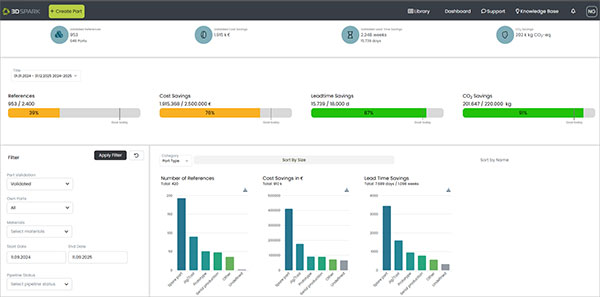
With 3D Spark, companies simply upload CAD, PDFs, or metadata to evaluate manufacturability at scale and benchmark technologies. Beyond cost and lead-time insights, the platform also delivers a detailed CO₂ footprint for each part.
Emissions are broken down across material, build process, and post-processing, giving teams transparency to compare options, improve efficiency, and make more sustainable manufacturing decisions.
Key Benefits:
For more product details, click here.
Sources: Press materials received from the company and additional information gleaned from the company’s website.


DE's editors contribute news and new product announcements to Digital Engineering. Press releases may be sent to them via [email protected].
Follow DE






About Us · Contact Us · Editorial Team · Advertising · Privacy Policy · Subscriber Services · © 2026 Digital Engineering 24/7 · Peerless Media