Helping design and engineering professionals discover, evaluate and specify technologies and processes that shorten the design cycle and enable success.


Alert!
Digital Engineering ceased publication on July 1, 2026. This website remains available as an archive of engineering content.
For inquiries or information, please email [email protected].

May 2026 Special Focus: Artificial Intelligence in Design and Simulation
In this Special Focus Issue, learn about the latest developments in the integration of artificial intelligence into engineering workflows.

Design & Simulation Software Guide 2025
In this Special Issue, Digital Engineering presents its second annual guide to design and simulation software vendors.
DEWESoft has introduced many math functions to the data acquisition system, including a formula editor, user-programmable FIR and IIR filtering, statistical analysis (min, max, ave, RMS, standard deviation, et al), single and three-phase power grid analysis, frequency response functions from modal analysis, order tracking, rotational and torsional vibration, engine combustion analysis, sound analysis, and several more powerful functions. However, due to the internal structure of DEWESoft, it was only possible for these features to be calculated during the measurement stage. It was not possible, for example, to record raw data and then go back and add filtering or re-scaling, or any of the useful analytical features mentioned above.
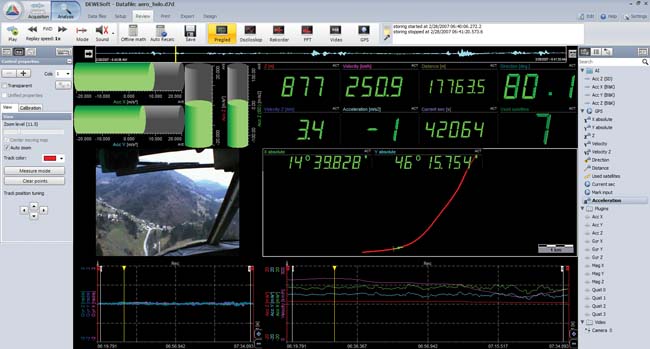 |
With the release of DEWESoft version 7, that has changed. Not only can all analytical functions be performed on data that has already been captured, but many new capabilities have been added to DEWESoft’s suite of functions.
DEWESoft 7 users can store “raw” data and perform all of their processing offline, on any computer. This allows them to work with the data as if they were at the test bench or on the proving ground. Math functions can be set up in advance and processed in real time, or set to process later, or not added at all until after recording, in any combination.
New and enhanced features that are now a part of DEWESoft include:
DEWESoft 7 is available in several versions, as follows:
For more information, please visit Dewetron.


DE's editors contribute news and new product announcements to Digital Engineering. Press releases may be sent to them via [email protected].
Follow DE
Join over 90,000 engineering professionals who get fresh engineering news as soon as it is published.






About Us · Contact Us · Editorial Team · Advertising · Privacy Policy · Subscriber Services · © 2026 Digital Engineering 24/7 · Peerless Media