Helping design and engineering professionals discover, evaluate and specify technologies and processes that shorten the design cycle and enable success.


Alert!
Digital Engineering ceased publication on July 1, 2026. This website remains available as an archive of engineering content.
For inquiries or information, please email [email protected].

May 2026 Special Focus: Artificial Intelligence in Design and Simulation
In this Special Focus Issue, learn about the latest developments in the integration of artificial intelligence into engineering workflows.

Design & Simulation Software Guide 2025
In this Special Issue, Digital Engineering presents its second annual guide to design and simulation software vendors.
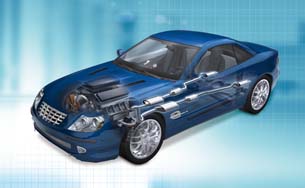 |
The dSPACE ASM Diesel Exhaust Model, one of the Automotive Simulation Models (ASMs), provides a virtual diesel exhaust aftertreatment system. In addition to the submodel for urea injection (the selective catalytic reduction system), it includes further submodels for a diesel oxidation catalyst (DOC) and a diesel particle filter (DPF). The simulation model can be used throughout the development process, from controller design in Simulink to ECU testing on a dSPACE simulator.
The limits for nitrates in diesel engine emissions defined by international standards such as EPA 2010 TIER IV (from the USA's Environmental Protection Agency) and EURO 6 (in the European Union) are becoming increasingly strict, according to dSPACE. Compliance with these tougher limits is not possible without electronically controlled catalytic converters. The company says selective catalytic reduction (SCR) systems that use urea injection (with AdBlue) are an effective solution.
With the model, users have access to all its Simulink blocks. They can view the modeled functions and adapt them to specific requirements themselves. The exhaust model's individual components (DOC, DPF, SCR) can be combined in different ways and configured for the aftertreatment system under test.
The model can be used to represent the physical and chemical processes in modern aftertreatment systems: urea decomposition for catalytic reduction, fuel post-injections for catalytic oxidation, soot particle filtering and DPF regeneration. It contains AdBlue dosing systems with and without air supply and simulates temperature, pressure and lambda sensors.
For more information, visit dSPACE.
Sources: Press materials received from the company and additional information gleaned from the company's website.


DE's editors contribute news and new product announcements to Digital Engineering. Press releases may be sent to them via [email protected].
Follow DE






About Us · Contact Us · Editorial Team · Advertising · Privacy Policy · Subscriber Services · © 2026 Digital Engineering 24/7 · Peerless Media