Helping design and engineering professionals discover, evaluate and specify technologies and processes that shorten the design cycle and enable success.



Dear DE Reader:
3D printing as a technology segment is on a fascinating trip these days. One of the more interesting outfits is called Carbon. When it comes to technology, pricing and the vision thing, nothing about these guys is the same old same old.
Carbon just released a new version of its 3D print software for its line of printers. This software is more than an import, slice and monitor tool. It's really an intelligent enabler.
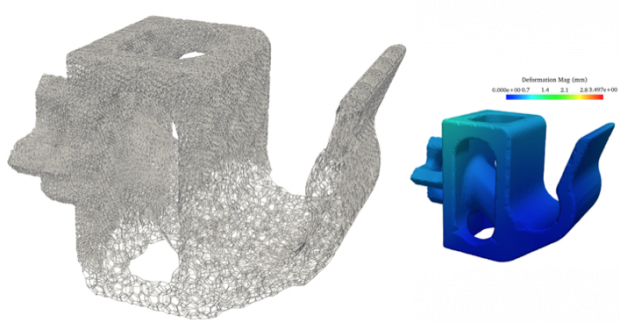
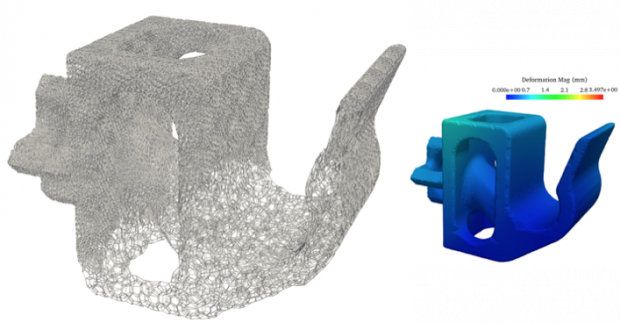 Carbon has released a new version of its 3D print software. Among its features is the ability to correct a deformation problem by automatically generating an appropriate lattice based on the desired performance. Image courtesy of Carbon Inc.
See, to make parts the printers use DLS (digital light synthesis) based on the company’s proprietary CLIP (continuous liquid interface production) technology. This process uses digital light projection, oxygen-permeable optics and programmable liquid resins.
Carbon says that the parts are like injection-molded parts. They have consistent and predictable mechanical properties. At the end of today's Editor's Pick of the Week write-up you'll find a link to more technical details on the DLS process. Check it out.
The software, called Carbon, lets you work with those programmable liquid resins. It gives you control of the chemical reactions in the printing process. It runs in a browser. As long as the 3D printers and your workstation or iPad are connected to the same network, you can use it.
Carbon is backed by secure, cloud-based FEA (finite element analysis). It has features like the ability to simulate the heat generated during a print job across the build area. It can evaluate potential hot spots and compensate for things like heat-induced shrinkage. You can simulate stress buildup during printing, helping you predict and fix potential production issues.
The software also provides the needed capabilities for managing a fleet of 3D printers for large-volume manufacturing. Carbon calls this linking of its 3D printers and related production equipment SpeedCell. A video and more on SpeedCell is available by clicking the second link at the end of today's main write-up.
The latest release of Carbon introduces a cloud-powered auto support feature that analyzes parts to help you understand where more may be needed. It also debuts new fence supports that help print edges with precision, minimize material usage and produce parts with minimal support artifacts.
You can learn more about the features and enhancements to Carbon in today's Editor's Pick of the Week write-up. Your best bet, however, is to poke around the Carbon website. You'll find price lists, details on materials, case studies and all sorts of fascinating stuff. Well worth it.
Thanks, Pal. – Lockwood
Anthony J. Lockwood
Editor at Large, DE


Anthony J. Lockwood is Digital Engineering's founding editor. He is now retired. Contact him via [email protected].
Follow DE
Join over 90,000 engineering professionals who get fresh engineering news as soon as it is published.






About Us · Contact Us · Editorial Team · Advertising · Privacy Policy · Subscriber Services · © 2026 Digital Engineering 24/7 · Peerless Media