Helping design and engineering professionals discover, evaluate and specify technologies and processes that shorten the design cycle and enable success.


Alert!
Digital Engineering ceased publication on July 1, 2026. This website remains available as an archive of engineering content.
For inquiries or information, please email [email protected].

May 2026 Special Focus: Artificial Intelligence in Design and Simulation
In this Special Focus Issue, learn about the latest developments in the integration of artificial intelligence into engineering workflows.

April 2026 Special Focus Issue: Generative Design
In this Special Focus Issue, Digital Engineering takes a look at how generative design solutions can be used across different types of design problems and with a variety of manufacturing approaches to accelerate design space exploration, and…
Artificial intelligence (AI) is transforming engineering in nearly every industry and application area. Accompanying this transformation are requirements for highly accurate AI models. Indeed, AI models can often be more accurate as they replace traditional methods, yet this accuracy sometimes comes at a price: how is this complex AI model making decisions, and how can we, as engineers, verify that the results are working as expected?
Enter explainable AI—a set of tools and techniques that help us understand model decisions and uncover problems with black-box models like bias or susceptibility to adversarial attacks. Explainability can help those working with AI to understand how machine learning models arrive at predictions, which can be as simple as understanding which features drive model decisions but more difficult when trying to explain complex models.
Why the push for explainable AI? Models weren’t always this complex. In fact, consider a simple example of a thermostat in winter. The rule-based model is as follows:
Is the thermostat working as expected? The variables are current room temperature and whether the heater is working, so it is very easy to verify based on the temperature in the room.
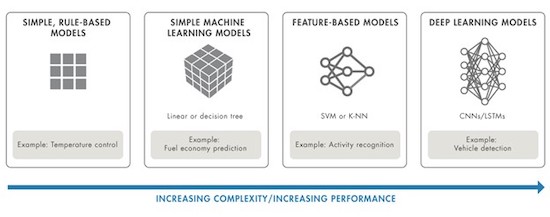
Fig. 1: Evolution of AI models. A simple model may be more transparent, while a more sophisticated model can improve performance.
Certain models, such as temperature control, are inherently explainable due to the simplicity of the problem, or an inherent, “common sense” understanding of the physical relationships. Generally, for applications where black-box models aren’t acceptable, using simple models that are inherently explainable may work and be accepted as valid if sufficiently accurate.
However, moving to more advanced models has advantages:
AI models are often referred to as “black boxes,” with no visibility into what the model learned during training, or how to determine whether the model will work as expected in unknown conditions. The focus on explainable models aims to ask questions about the model to uncover any unknowns and explain their predictions, decisions and actions.
For all the positives about moving to more complex models, the ability to understand what is happening inside the model becomes increasingly challenging. Therefore, engineers need to arrive at new approaches to ensure they can maintain confidence in the models as predictive power increases.
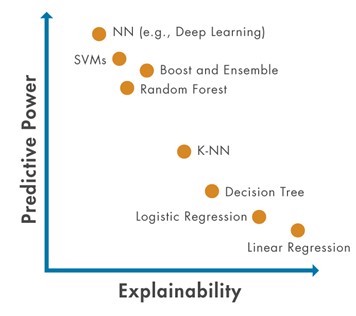
Fig. 2: More powerful models tend to be less explainable, and engineers will need new approaches to explainability to make sure they can maintain confidence in the models as predictive power increases.
Using explainable models can provide the most insight without adding extra steps to the process. For example, using decision trees or linear weights can provide exact evidence as to why the model chose a particular result.
Engineers who require more insight into their data and models and who are driving explainability research for:
Confidence in models: Many stakeholders are interested in the ability to explain a model based on its role and interaction with the application. For example:
Regulatory requirements: There is an increasing desire to use AI models in safety-critical and governance and compliance applications that may have internal and external regulatory requirements. Although each industry has specific requirements, providing evidence of robustness of training, fairness and trustworthiness may be important.
Identifying bias: Bias can be introduced when models are trained on data that is skewed or unevenly sampled. Bias is especially concerning for models applied to people. It’s important for model developers to understand how bias could implicitly sway results, and to account for it so AI models “generalize” or provide accurate predictions without implicitly favoring groups and subsets.
Debugging models: For engineers working on models, explainability can help analyze incorrect model predictions. This can include evaluating issues within the model or the data. A few specific explainability techniques that can help with debugging are described in the following section.
Explainable methods fall into two categories:
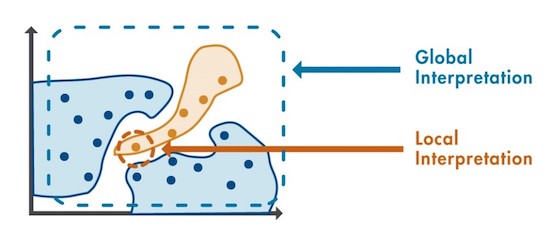
Fig. 3: The difference between global and local methods. Local methods focus on a single prediction, while global methods focus on multiple predictions.
Global methods include feature ranking, which sorts features by their impact on model predictions, and partial dependence plots, which target one specific feature and indicate its impact on model predictions across the whole range of its values.
The most popular local methods are:
When building models for image processing or computer vision applications, visualizations are one of the best ways to assess model explainability.
Model visualizations: Local methods like Grad-CAM and occlusion sensitivity can identify locations in images and text that most strongly influenced the prediction of the model.
Feature comparisons and groupings: The global method T-SNE is one example of using feature groupings to understand relationships between categories. T-SNE does a good job of showing high-dimensional data in a simple two-dimensional plot.
These are only a few of the many techniques currently available to help model developers with explainability. Regardless of the details of the algorithm, the goal is the same: to help engineers gain a deeper understanding about the data and model. When used during AI modeling and testing, these techniques can provide more insight and confidence into AI predictions.
Explainability helps overcome an important drawback of many advanced AI models and their black-box nature. But overcoming stakeholder or regulatory resistance against black-box models is only one step towards confidently using AI in engineered systems. AI used in practice requires models that can be understood, that were constructed using a rigorous process, and that can operate at a level necessary for safety-critical and sensitive applications.
Continuing areas of focus and improvement include:
The future of AI will have a strong emphasis on explainability. As AI is incorporated into safety-critical and everyday applications, scrutiny from internal stakeholders and external users likely will increase. Viewing explainability as essential benefits everyone. Engineers have better information to debug their models to ensure the output matches their intuition. They gain more insight to meet requirements and standards. And, they can focus on increased transparency for systems that keep getting more complex.
Johanna Pingel is product marketing manager at MathWorks.

The MathWorks is the world's leading developer of technical computing and Model-Based Design software for engineers and scientists in industry, government, and education. With an extensive product set based on MATLAB® and Simulink®,…






About Us · Contact Us · Editorial Team · Advertising · Privacy Policy · Subscriber Services · © 2026 Digital Engineering 24/7 · Peerless Media