Helping design and engineering professionals discover, evaluate and specify technologies and processes that shorten the design cycle and enable success.



May 2026 Special Focus: Artificial Intelligence in Design and Simulation
In this Special Focus Issue, learn about the latest developments in the integration of artificial intelligence into engineering workflows.

April 2026 Special Focus Issue: Generative Design
In this Special Focus Issue, Digital Engineering takes a look at how generative design solutions can be used across different types of design problems and with a variety of manufacturing approaches to accelerate design space exploration, and…
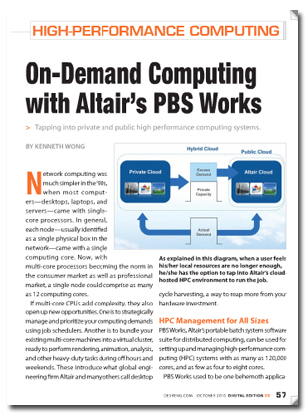
High-performance computing (HPC), which has remained the exclusive playground for large enterprises and university researchers till recently, still raises lots of questions for engineers and designers. I don't have all the answers, but I know a few people who do. One of them is Dr. Bill Nitzberg, CTO of PBS Works, Altair Engineering.
For my print article titled "On-Demand Computing with PBS Works" (October 2010), I interviewed Nitzberg's colleague Robert Walsh, Altair's director of business development for PBS GridWorks. In the podcast below, Nitzberg picks up where Walsh left off to explain:

About Bill Nitzberg
With over 25 years in the computer industry, spanning commercial software development to high-performance computing research, Dr. Bill Nitzberg is an internationally recognized expert in parallel and distributed computing. He has served on the board of the Open Grid Forum, co-architected NASA’s Information Power Grid, edited the MPI-2 I/O standard, and published numerous papers on distributed shared memory, parallel I/O, PC clustering, job scheduling, and Grid/Cloud computing. In his spare time, Bill tries to reduce his pack weight for his long-distance hiking trips.



Kenneth Wong is Digital Engineering's resident blogger and senior editor. Email him at [email protected] or share your thoughts or suggestions at digitaleng.news/facebook.
Follow DE
Join over 90,000 engineering professionals who get fresh engineering news as soon as it is published.






About Us · Contact Us · Editorial Team · Advertising · Privacy Policy · Subscriber Services · © 2026 Digital Engineering 24/7 · Peerless Media