Helping design and engineering professionals discover, evaluate and specify technologies and processes that shorten the design cycle and enable success.



May 2026 Special Focus: Artificial Intelligence in Design and Simulation
In this Special Focus Issue, learn about the latest developments in the integration of artificial intelligence into engineering workflows.

Design & Simulation Software Guide 2025
In this Special Issue, Digital Engineering presents its second annual guide to design and simulation software vendors.
ANSYS, Inc. has announced that the Italian car manufacturer, Ferrari, uses software from ANSYS to optimize automobile design and performance. The latest improvement involves the use of software from ANSYS to predict thermal comfort in the vehicle’s interior.
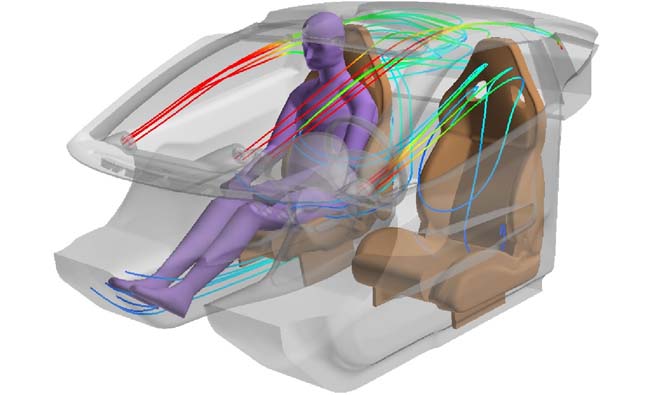 Image courtesy of ANSYS, Inc. |
In order to assess comfort not only qualitatively but also quantitatively, Ferrari worked together with the University of Pisa in Italy to define thermal comfort indices and to make comprehensive evaluations of the general aspects of thermal comfort. Because an experimental approach was not practical, the investigating engineering team used fluid dynamics software from ANSYS to perform the calculations.
“Thermal comfort is an individual perception and not a measurable value,” said Giovanni Lombardi, professor of airplane aerodynamics and vehicle aerodynamics at the University of Pisa. “Qualitative statements from a test team do not really help car developers who want to measure the design quality and usefulness of design changes objectively and comparably. An experimental approach for determining the data required was virtually impossible. For that reason, we used engineering simulation software from ANSYS, which had advantages for this scenario and rendered accurate and reliable results.”
The research team based its resulting “global thermal comfort index” on several local indices: the thermal equilibrium of the human body, discomfort caused by drafts, and horizontal and vertical temperature gradients. A number of factors were studied, including the car’s velocity and materials (leather, glass, aluminum) as well as sensitivity to warming or cooling on various body sites (leg, arm, face, covered with clothing or not), solar irradiance, vehicle interior size, and air flow.
For more information, visit ANSYS.
Sources: Press materials received from the company and additional information gleaned from the company’s website.


DE's editors contribute news and new product announcements to Digital Engineering. Press releases may be sent to them via [email protected].
Follow DE
Join over 90,000 engineering professionals who get fresh engineering news as soon as it is published.






About Us · Contact Us · Editorial Team · Advertising · Privacy Policy · Subscriber Services · © 2026 Digital Engineering 24/7 · Peerless Media