Helping design and engineering professionals discover, evaluate and specify technologies and processes that shorten the design cycle and enable success.



May 2026 Special Focus: Artificial Intelligence in Design and Simulation
In this Special Focus Issue, learn about the latest developments in the integration of artificial intelligence into engineering workflows.

April 2026 Special Focus Issue: Generative Design
In this Special Focus Issue, Digital Engineering takes a look at how generative design solutions can be used across different types of design problems and with a variety of manufacturing approaches to accelerate design space exploration, and…
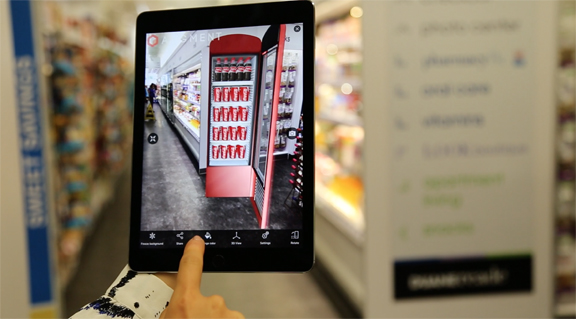
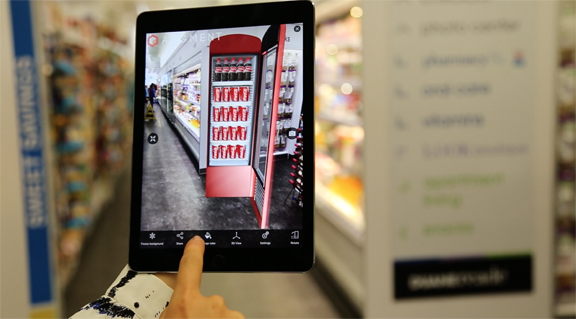 Seeing what's not there -- an example of the use of augmented reality to understand product placement (image courtesy of Augment).
An AI (artificial intelligence) expert, an AR (augmented reality) expert, and a generative design expert walk into a bar ...
Well, they didn't exactly get together in person, but in our LIVE roundtable discussion (now available for on-demand viewing here), AI and machine-learning expert Jerry Overton from CSC Research, enterprise AR vendor Augment's founder and CEO Jean-Francois Chianetta, and generative design software maker Frustum's CEO Jesse Blankenship sat down (in a manner of speaking) to talk about the practical applications of these seemingly farfetched technologies.
Overton said, "Smart machines are changing manufacturing. They're changing how we implement technologies like AR. They're also changing the process of manufacturing itself."
AR and its close cousin VR (virtual reality) have a long history in videogames and films, but today, they're also seeping into manufacturing. Smart plants, which some may argue is more a vision than a reality at the present, makes use of AR/VR, by superimposing a layer of digital information onto the user's view of his or her surroundings to offer new insights.
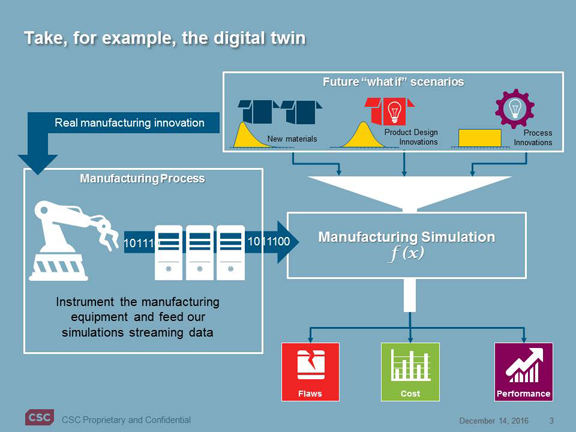 Data scientist and AI expert Jerry Overton discusses the rise of digital twins as one of the resulting phenomenons of technology convergence (image courtesy of CSC, Jerry Overton).
Such a setup would, for example, show a worker how he or she might interact with a new piece of machine -- even when the machine only exists as a digital model and has not yet been built or installed. They may also become critical in collision detection and clash detection using digital plant models. After all, catching and fixing your ill-filled assembly problems in the digital real is much more cost-effective than doing the same when the rigs, jigs, and steel frames are already built and mounted.
Blankenship weighs in with a clarification of the difference between CAD modelers and algorithm-driven optimization software. "The big difference is, typically with CAD, the designer has to draw and shape the entire part, then work with a stress analyst to test the part ... With topology optimization, typically the stress analyst has used it to give the designer an inspirational model [the rough shape as a starting point] ... We thought about [the problem] from the designer's perspective, to understand how they can work with such free-form geometry."
Overton points out, "It's not generally common to embed machine learning or AI in design software. There are companies working on it, but a lot of the initiatives are still in research and development. But we are seeing intelligent interfaces in design software ... In those, it's pretty common to see the use of machine learning to narrow down the design options or to predict the performance of a design."
Though unplanned, the three panelists quickly discovered many areas where their technologies intersect.
Overton is writing a blog post titled "How to get started with machine learning in manufacturing." To read, visit CSC's data science blog here.


Kenneth Wong is Digital Engineering's resident blogger and senior editor. Email him at [email protected] or share your thoughts or suggestions at digitaleng.news/facebook.
Follow DE
Join over 90,000 engineering professionals who get fresh engineering news as soon as it is published.






About Us · Contact Us · Editorial Team · Advertising · Privacy Policy · Subscriber Services · © 2026 Digital Engineering 24/7 · Peerless Media