Helping design and engineering professionals discover, evaluate and specify technologies and processes that shorten the design cycle and enable success.


Alert!
Digital Engineering ceased publication on July 1, 2026. This website remains available as an archive of engineering content.
For inquiries or information, please email [email protected].

Digital Engineering April 2026
In the latest issue of Digital Engineering, we take a look at the latest innovations in design for additive manufacturing, including the use of natural language inputs, social media cosplayers, and AI integration. The issue also includes a feature…

January Special Focus Issue: Design for Additive
In this Special Focus Issue of Digital Engineering, learn about the latest advancements in design for additive manufacturing, including new software tools, additive in automotive, custom medical devices, and more.
Stratasys Ltd. and Ricoh USA, Inc. announces the enrollment of the first patient in a clinical study aimed to evaluate the use of 3D printed models for orthopedic oncology. The study will assess the efficacy of patient-specific 3D printed anatomical models for preoperative planning and tumor excision in comparison to the current standard of care, which relies solely on computed tomography or magnetic resonance imaging.
The joint research aims to demonstrate improvements in surgical outcomes, including reduced blood loss, shorter operating time including time under anesthesia, and decreased risk of procedural complications. Clinical outcomes will be compared between an experimental group in which tumors are excised using 3D printed models alongside imaging for planning, and an active comparator group in which tumor excision will be prepped solely with imaging.
Benefits of 3D printed models in preoperative planning can impact medical practitioners and patients. Doctors and surgeons benefit from improved, informed presurgical planning before operations. Unlike the limitations of computer images, this enables doctors to represent vital aspects of patient anatomy with life-size physical replicas, granting them the means to simulate procedures. In turn, the availability of accurate 3D printed models to better communicate planned procedures, together with an improved surgical process, helps improve patient outcome and recovery.
The prospective, multi-center randomized controlled study is expected to run for 12 months and involve up to 150 subjects across three sites. The two sites that have agreed to date to participate are The Ohio State University Wexner Medical Center and Corewell HealthTM, based in Michigan.
“Our never-ending mission is to improve patient outcomes, and that starts with preoperative planning,” says Kyle K. VanKoevering, MD associate professor, Otolaryngology—Head and Neck Surgery, Ohio State Wexner Medical Center. “We look forward to participating in this study to examine how 3D printed models may help the medical staff better prepare for surgery as well as improve patient education.”
“Being one of the sites to participate in this study puts us on the forefront of demonstrating new technologies that can advance patient care and improve health outcomes,” says Aws Hammad, M.D., clinical faculty of orthopaedic surgery at Corewell Health William Beaumont University Hospital. “Addressing the challenges that come along with bone sarcomas and utilizing the power of patient-specific 3D modeling is a significant step in not only patient education but as an aid to surgeons for more precise surgical procedures.”
“The collaboration brings together unparalleled experience and innovation in medical imaging and 3D printing and, if successful, may establish anatomical models as a new standard for patient treatment in tumor removal from bones,” says Erez Ben Zvi, vice president Medical at Stratasys.
“We are thrilled to co-sponsor this important clinical trial alongside our longstanding partners at Stratasys to further demonstrate the potential impact of 3D patient-specific modeling as well as accelerate adoption of this technology to better serve a broader population,” says Gary Turner, managing director, Additive Manufacturing, Ricoh USA.
Sources: Press materials received from the company and additional information gleaned from the company’s website.


Every day, our customers find simpler, smarter approaches to stubborn design problemsand greater confidence to confront towering human and technological challenges. Less hindered by the usual constraints, they can imagine, design, iterate and…
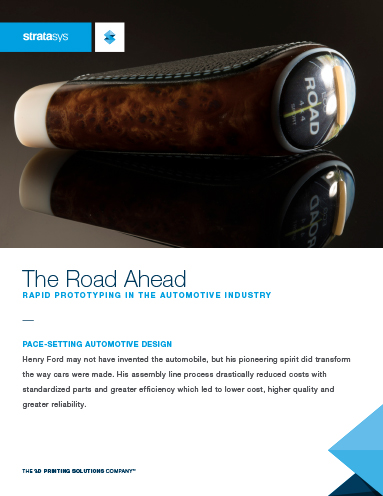
Rapid Prototyping in The Automotive Industry
Henry Ford may not have invented the automobile, but his pioneering spirit did transform the way cars were made. His assembly line process drastically reduced costs with standardized parts and greater efficiency which led to lower cost, higher quality and greater reliability.

DE's editors contribute news and new product announcements to Digital Engineering. Press releases may be sent to them via [email protected].
Follow DE






About Us · Contact Us · Editorial Team · Advertising · Privacy Policy · Subscriber Services · © 2026 Digital Engineering 24/7 · Peerless Media