Helping design and engineering professionals discover, evaluate and specify technologies and processes that shorten the design cycle and enable success.


Alert!
Digital Engineering ceased publication on July 1, 2026. This website remains available as an archive of engineering content.
For inquiries or information, please email [email protected].

May 2026 Special Focus: Artificial Intelligence in Design and Simulation
In this Special Focus Issue, learn about the latest developments in the integration of artificial intelligence into engineering workflows.

April 2026 Special Focus Issue: Generative Design
In this Special Focus Issue, Digital Engineering takes a look at how generative design solutions can be used across different types of design problems and with a variety of manufacturing approaches to accelerate design space exploration, and…
Five finalists in a three-year Mobility Unlimited Challenge have been unveiled at CES in Las Vegas. The Toyota Mobility Foundation launched the $4 million global challenge in 2017 in partnership with Nesta’s Challenge Prize Centre, with the aim of improving the lives of millions of people with lower-limb paralysis.
The Challenge invited engineers, innovators and designers from across the world to submit designs for game-changing technologies, incorporating intelligent systems, to improve the mobility and independence of people with lower-limb paralysis. Central to the Challenge is the importance of collaboration with end-users to develop devices which will integrate seamlessly into users’ lives and environments, while being comfortable and easy to use, enabling greater independence and increased participation in daily life.
Each of the five finalists will receive a grant of $500,000 to develop their concept further, with the final winner of the Challenge receiving $1 million in Tokyo in 2020.
The five finalists are:
|
|
|
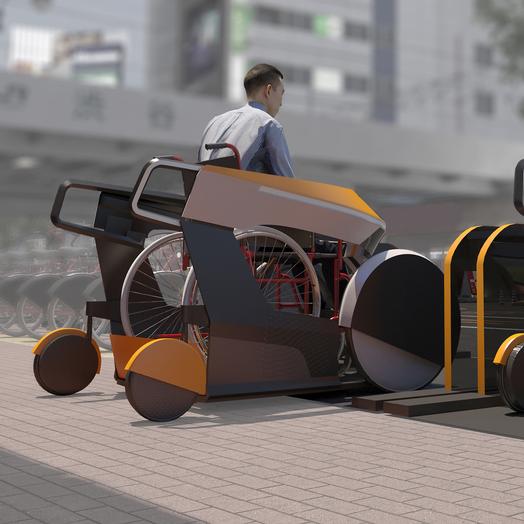 Moby: Italdesign (Italy), is an integrated network of wheel-on powered devices, allowing users of manual wheelchairs the convenience and benefits of a powered chair, accessible via an app-based share scheme. |
|
 Phoenix Ai Ultralight Wheelchair: Phoenix Instinct (United Kingdom) is an ultra-lightweight, self-balancing, intelligent wheelchair which eliminates painful vibrations. |
|
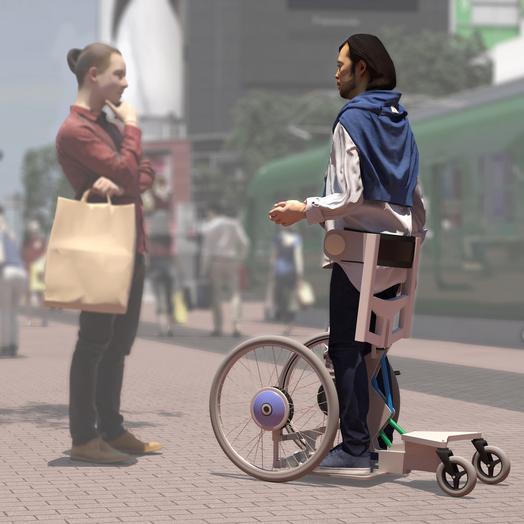 Qolo (Quality of Life with Locomotion): Team Qolo, University of Tsukuba (Japan) designed a mobile exoskeleton on wheels, allowing users to sit or stand with ease. |
|
 Quix: IHMC & MYOLYN (United States), is a highly mobile, powered exoskeleton offering fast, stable and agile upright mobility. |
Eighty entries were received from specialist teams in 28 countries globally. The finalists were chosen by a panel of expert judges.
“There are so many technological opportunities to explore approaches to alleviate challenges stemming from lower-limb paralysis," said Dr. Eric Krotkov, Chief Science Officer at Toyota Research Institute and one of the judges of the Challenge. "A competition like the Mobility Unlimited Challenge gets innovators to focus on the same problem to identify something of great common interest that serves society. I am excited by these finalists who have a breadth of technical approaches—wheelchairs, orthotics, braces, exoskeletons. I look forward to seeing how they will take these devices out of their conceptual stage to help our end users.”
In addition to the $500,000 grant, the finalists will attend tailored workshops, receive mentoring opportunities with engineering experts, and collaborate with end users to further the development of their concepts through to 2020.
To ensure entries from organizations of all sizes, the Challenge also offered 10 teams seed funding in the form of $50,000 Discovery Award grants during the entry period. Of the 10 Discovery Award winners, four went on to be selected as finalists.
“Current personal mobility devices are often unable to fully meet the needs of users due to limitations affecting functionality and usability," said Charlotte Macken of Nesta’s Challenge Prize Centre. "Historically, the pace of innovation is slow, due to small and fragmented markets and difficulties in getting new technology funded by health-care systems and insurers. This can make the field unattractive to the very people who could help change the world. We hope that challenges like this can inspire innovation and are excited to see how the five finalists use this opportunity to develop their ideas further.”
Around the world, millions of people are living with lower-limb paralysis (the most common causes being strokes, spinal cord injury and multiple sclerosis). While there are no statistics on paralysis worldwide, the World Health Organization estimates there are 250,000-500,000 new cases of spinal cord injury globally every year.
For more information, read Exoskeletons on the Move.
Source: Press release and company website.


DE's editors contribute news and new product announcements to Digital Engineering. Press releases may be sent to them via [email protected].
Follow DE






About Us · Contact Us · Editorial Team · Advertising · Privacy Policy · Subscriber Services · © 2026 Digital Engineering 24/7 · Peerless Media