Helping design and engineering professionals discover, evaluate and specify technologies and processes that shorten the design cycle and enable success.




May 2026 Special Focus: Artificial Intelligence in Design and Simulation
In this Special Focus Issue, learn about the latest developments in the integration of artificial intelligence into engineering workflows.

April 2026 Special Focus Issue: Generative Design
In this Special Focus Issue, Digital Engineering takes a look at how generative design solutions can be used across different types of design problems and with a variety of manufacturing approaches to accelerate design space exploration, and…
Although prototyping alone used to be enough to attract automobile manufacturers to AM, companies have begun to demand more from new technology investments. Companies have not only begun to expect the systems to produce parts faster, but also expect a certain level of practical use for a 3D printed part. The need for better and faster 3D printing led Ford to form a partnership with Carbon3D.
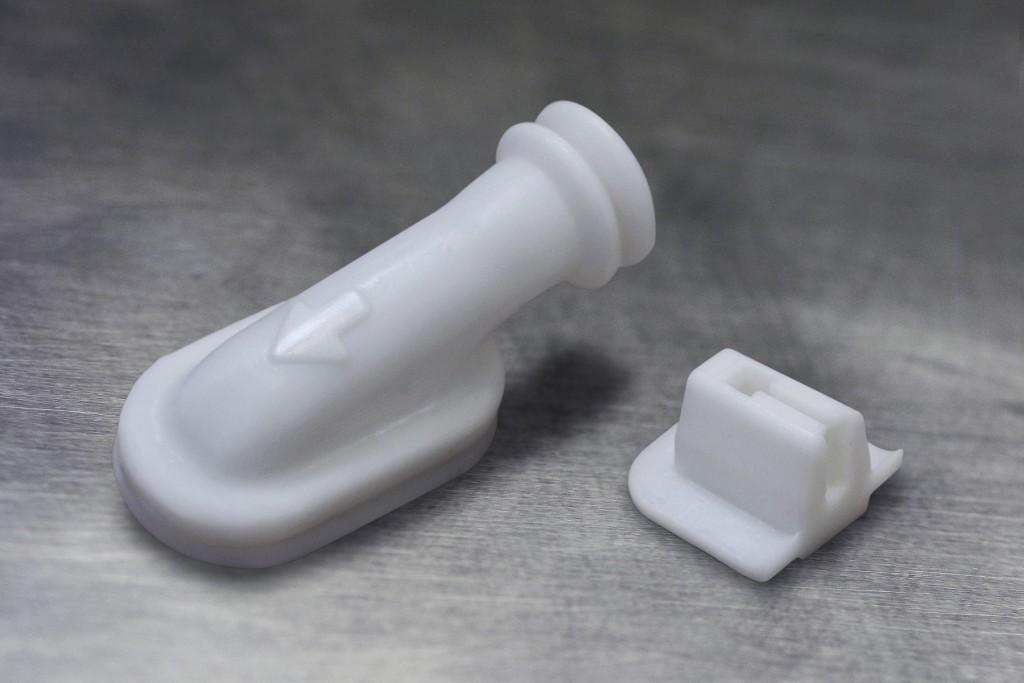 These grommets were designed to help protect wiring inside the door of Ford's Focus Electric. Courtesy of Carbon3D.
“Carbon3D’s CLIP technology has allowed us to realize our need for high-speed, high-quality printing of actual automotive-grade parts,” said Raj Nair, group VP of global product development and CTO. “We are excited to further our relationship and look forward to innovating together to make 3D manufacturing a reality.”
Unlike some other AM processes, Carbon3D’s systems produce parts through chemical reaction, rather than mechanical precision. Rather than building parts layer by layer, Carbon3D’s photochemical process almost grows a part, drawing together the material into the desired shape without the strata usually associated with AM. The company has dubbed the process CLIP, which stands for continuous liquid interface production technology.
Ford has used both more traditional AM process and Carbon3D’s process to design and produce elastomer grommets for the Focus Electric. The result, according to Carbon3D, was the CLIP process was able to produce the grommets in less than a third of the time required by standard AM processes. Additionally, the parts produced were much closer to the final material properties expected for the grommets than other 3D printed parts.
“We’re thrilled. The parts we’ve produced are mechanically strong, just like injection molded parts. That’s the target we’ve set for an automotive grade part,” said Ellen Lee, team leader, AM research at Ford. “The chemistry that Carbon3D has based their resins on has significant potential to yield functional, durable materials. We’re excited to be able to tap into their technology to create new automotive relevant materials and applications for digital manufacturing. It’s revolutionary.”
Below you’ll find a TED Talk from Joseph DeSimone, CEO and co-founder of Carbon3D.
Source: Carbon3D


John Newman is a Digital Engineering contributor who focuses on 3D printing. Contact him via [email protected] and read his posts on Rapid Ready Technology.
Follow DE
Join over 90,000 engineering professionals who get fresh engineering news as soon as it is published.






About Us · Contact Us · Editorial Team · Advertising · Privacy Policy · Subscriber Services · © 2026 Digital Engineering 24/7 · Peerless Media