Helping design and engineering professionals discover, evaluate and specify technologies and processes that shorten the design cycle and enable success.


Alert!
Digital Engineering ceased publication on July 1, 2026. This website remains available as an archive of engineering content.
For inquiries or information, please email [email protected].

May 2026 Special Focus: Artificial Intelligence in Design and Simulation
In this Special Focus Issue, learn about the latest developments in the integration of artificial intelligence into engineering workflows.

April 2026 Special Focus Issue: Generative Design
In this Special Focus Issue, Digital Engineering takes a look at how generative design solutions can be used across different types of design problems and with a variety of manufacturing approaches to accelerate design space exploration, and…
As part of a wide-scale effort to integrate 3D printing into all avenues of its product development and manufacturing processes, Ford is pursuing a pilot project to jump-start the design of tools and fixtures, including making it easier for plant floor workers to produce components on their own without help from experienced experts.
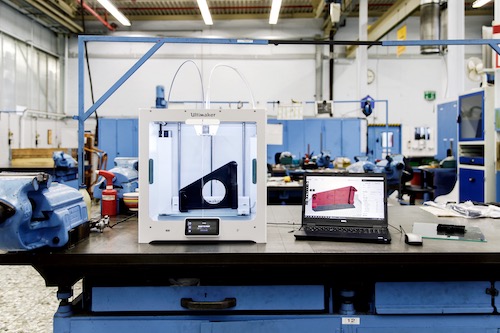
Ford’s Cologne, Germany, pilot plant maintains a small-scale manufacturing line, which develops cars years before they go into production. As part of their efforts, the team has been honing an optimized workflow to create jigs, tools and fixtures at local plants using 3D printing techniques as opposed to subbing out the components to external partners. Ford has established a dedicated 3D printing workshop at the pilot plant, which allows engineers to iterate custom tool designs to meet their goals of accelerating time to market on key vehicle programs, but also to ensure ergonomic benefits for its workforce.
As part of the initiative, Ford’s team has installed Ultimaker 3D printers in the Cologne, Germany, factory, among other European facilities. The Ultimaker printers’ open filament approach enables Ford engineers to take advantage of an array of industrial-grade materials, allowing for greater flexibility in designs, Ford officials say.
“Open filament is very important to us because we can use different filaments from different companies, even use industrial filaments which help us to make very durable tools and fixtures for our high-volume production,” says Raphael Koch, research engineer for Ford R&A Europe. To date, Ford has implemented more than 50 3D-printed tools for high-volume production as part of its Ford Focus vehicle program, an accomplishment that has translated into significant cost savings, Koch says.
Currently, skilled engineers model a tool design in Dassault Systemes CATIA and once it’s refined and validated, it is sent off to local plants, where it is 3D printed to use as part of the production process. Looking ahead, Ford is experimenting with software that will allow untrained plant workers to use the Ultimaker Cura software to create their own tools. The team is also testing use of Trinckle’s Paramate generative design software to simplify the tool design process so non-3D-modeling experts can get onboard.
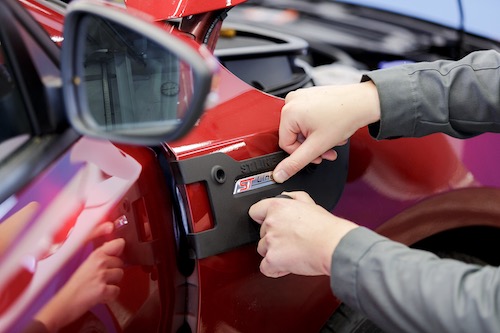
“Designing and printing a part is something that requires knowledge about 3D printing, CAD and understanding materials properties, and this kind of knowledge is sparse,” says Paul Heiden, senior vice president product management for Ultimaker. In a traditional workflow, plant workers would have to circle back to the skilled design expert to make any changes or adjustments, but the approach that Ford is pursuing would alleviate that need. “Instead of being dependent on someone at the central competency center, workers could do it themselves at a local level,” he explains.
While today, only skilled process engineers are designing the complex fixtures, Ford’s Koch explains the new workflow empower untrained workers to design and create their own tools and fixtures. Ford’s roadmap is to leverage 3D printing workflows to design spare parts, evolve to a design for additive manufacturing approach, and reach the ultimate goal—printing production parts for production vehicles.


From the very beginning, our mission has been to accelerate the world’s transition to local manufacturing and digital distribution. Our passion is to deliver a 3D printing system that drives business success across the world. That’s why…

Insider Q&A: 3D Printing End Use Parts
In this Insider Q&A, the experts at Ultimaker explain how 3D printing can be used for spare parts, jigs and fixtures in a production environment.

Beth Stackpole is a contributing editor to Digital Engineering. Send e-mail about this article to [email protected].
Follow DE






About Us · Contact Us · Editorial Team · Advertising · Privacy Policy · Subscriber Services · © 2026 Digital Engineering 24/7 · Peerless Media