Helping design and engineering professionals discover, evaluate and specify technologies and processes that shorten the design cycle and enable success.



May 2026 Special Focus: Artificial Intelligence in Design and Simulation
In this Special Focus Issue, learn about the latest developments in the integration of artificial intelligence into engineering workflows.

April 2026 Special Focus Issue: Generative Design
In this Special Focus Issue, Digital Engineering takes a look at how generative design solutions can be used across different types of design problems and with a variety of manufacturing approaches to accelerate design space exploration, and…
The point is, all those toys were cool. They were fun to play with and encouraged my imagination to come up with scenarios in which Yoda somehow defeated an AT-AT. Toys have become more sophisticated since then, but action figures will always be popular. What might make them even more popular is the addition of 3D printing.
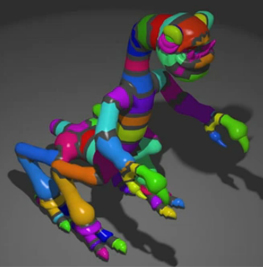
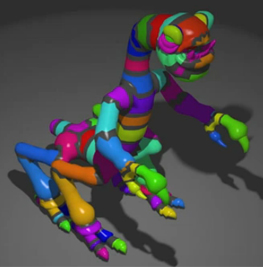
A group of graphics experts and computer scientists at Harvard thought so as well, and created a subtly sophisticated piece of software that translates video game character images (or other 3D animations) into CAD ready for 3D printing. The end product isn’t just a solid piece of plastic either. Each 3D model is analyzed and the software creates instructions for 3D printers that include articulation.
The work resulted in a paper titled “Fabricating Articulated Characters from Skinned Meshes” for the Association for Computing Machinery’s (ACM) journal.
“In animation you’re not necessarily trying to model the physical world perfectly; the model only has to be good enough to convince your eye,” said lead author Moritz Bächer, a graduate student in computer science at Harvard’s School of Engineering and Applied Sciences (SEAS).
“In a virtual world, you have all this freedom that you don’t have in the physical world. You can make a character so anatomically skewed that it would never be able to stand up in real life, and you can make deformations that aren’t physically possible. You could even have a head that isn’t attached to its body, or legs that occasionally intersect each other instead of colliding.”
Bächer and his colleagues used models from the video game Spore to test their software. The game allows players to design a vast array of different model types using a simplified rendering program. After the player has completed creating a model, the game uses procedural animation to animate the design.
In order to fabricate these designs using a 3D printer, Harvard researchers developed a software tool that creates a CAD model. To add articulation, the software then identifies the most logical location for joints and determines the best size and location of the joints for a real world model.
Don’t think this sort of technology is only good for toys. If you added printed electronics to the mix, you might be able to create on-demand robots that could perform a number of different useful tasks outside of entertaining the kids.
Below you’ll find a video that explains how the software was developed.
Source: Harvard


John Newman is a Digital Engineering contributor who focuses on 3D printing. Contact him via [email protected] and read his posts on Rapid Ready Technology.
Follow DE
Join over 90,000 engineering professionals who get fresh engineering news as soon as it is published.






About Us · Contact Us · Editorial Team · Advertising · Privacy Policy · Subscriber Services · © 2026 Digital Engineering 24/7 · Peerless Media