Helping design and engineering professionals discover, evaluate and specify technologies and processes that shorten the design cycle and enable success.


Alert!
Digital Engineering ceased publication on July 1, 2026. This website remains available as an archive of engineering content.
For inquiries or information, please email [email protected].


Sponsored
Artificial Intelligence for Design and Engineering Workflows
In this white paper, learn how artificial intelligence and machine learning can improve design and simulation.
Technology Focus: Designing for Optimization & Simulation
Simulation is pervasive, with people from different departments and backgrounds discovering new ways to put it to use, in all of its varied forms.
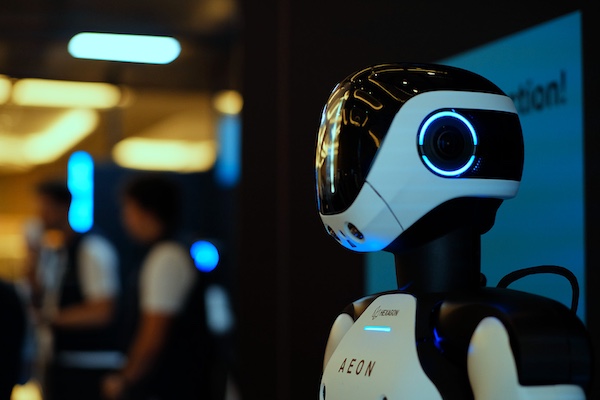
The 13th Hexagon Live Global, held in June in Las Vegas, NV, marked the premiere of Mattias Stenberg as the CEO of the Hexagon spinoff Octave; and the debut of Hexagon's humanoid robot AEON.
During the keynote, Mattias Stenberg, a 17-year veteran of Hexagon, and Ola Rollén, Hexagon's former CEO and current Chairman of the Board, engaged in a banter:
"I'm leaving Hexagon," said Stenberg.
"I've been trying to get rid of you. You leave on a high note," replied Rollén.
Hexagon press office reported that the event drew more than 3,000 customers, partners, influencers, and employees, from 59 countries.
At the event, Hexagon’s Geosystems division also announced that The Hexagon Digital Reality (HxDR) business unit is integrating NVIDIA Omniverse and adopting OpenUSD “to enable faster, more accessible creation of immersive, photorealistic digital twins from scanned data in the cloud,” according to a press release.
According to the companies, the integration accelerates the conversion of point cloud data into high-quality visualisations, reducing the reliance on specialised resources such as digital artistry or high-end desktop software. Running natively in the cloud, the new workflow allows users to rapidly produce detailed, photorealistic renderings. This integration also strengthens digital twin workflows by delivering near real-time visual context from captured reality.
Stenberg, President Hexagon’s Asset Lifecycle Intelligence (ALI) division, is not going away, but going up. He will be leading the new spinoff Octave, comprising Hexagon’s ALI, SIG (Safety, and Infrastructure & Geospatial) divisions. ETQ, the electronic quality management system (eQMS) maker Hexagon acquired in early 2025, and Bricsys, an AECO-focused CAD and BIM company Hexagon acquired in 2018, will become part of Octave.
"Octave will be a unicorn company from day one, designing, building and protecting the world’s most critical infrastructures. It will be a software-first company, digital, cloud native, built to scale," said Stenberg. "And we plan to launch it in the stock market early next year."
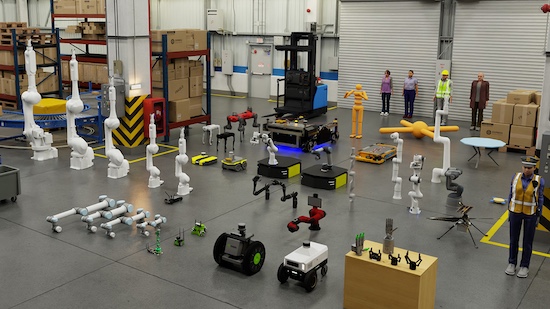
In a press briefing, Stenberg added, "We are the only company that can connect data from design to building and operation. There are lots of companies that have solutions for these different boxes, but we can natively connect the data throughout."
Hexagon expects the separation of the business divisions and the listing process to be completed in the first half of 2026.
On the show floor, the most popular selfie corner was next to the humanoid robot AEON. The company wrote, "AEON combines Hexagon’s world-class sensor suite with advanced locomotion, AI-driven mission control, and spatial intelligence to deliver exceptional agility, versatility, and awareness."
AEON is the product of Hexagon's newly formed Robotics division, led by Arnaud Robert. “Our vision is quite simple: to build an autonomous future, one humanoid at a time,” said Robert in the keynote.
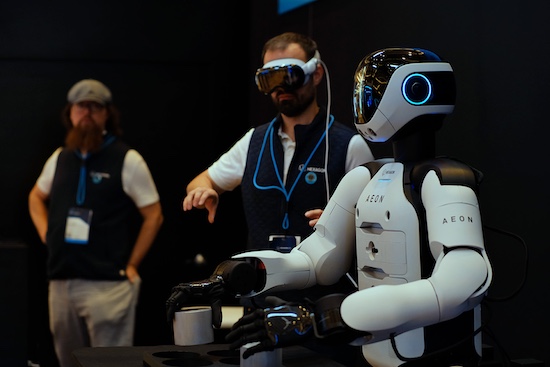
AEON is the result of a partnership with NVIDIA, Microsoft, and maxon, and is powered by NVIDIA accelerated computing, NVIDIA Omniverse, and NVIDIA Jetson.
Robert believes robots should be versatile and adaptable. "For example, the same robot should be able to move boxes around the factory, or inspect an automotive part ... One day it needs to sort small pieces, screws, bolts, which require high dexterity. And the next day, it needs to sort large parts, bulky parts from the engine," he said.
Reality capture is another important application, with robots being able to easily scan assets and environments, and generate 3D models. That scanned data can also be used to create high-fidelity digital twins that establish a data flywheel to continuously train AEON.
In Robert’s view, there are two compelling reasons to choose the humanoid form. “The first one is that the world as we know it was built by humans for humans, so it’s a form factor that can integrate directly into the vast infrastructure. The second reason is that, if you look at advancement in physical AI, specifically to enable versatility, the biggest promise is imitation learning,” he said.
The transfer of knowledge is a lot simpler if both the teacher and the robot have the same physical characteristics, Robert pointed out. AEON is capable of mimicking its human trainer's gestures, movements, and actions. At the conference, Hexagon demonstrated how, using VR, a human trainer was able to guide AEON through a sorting task.
There is one notable difference in AEON’s physique that sets it apart from the humans: Instead of human-like feet, it’s balanced on wheels, giving it the advantage of speed and smooth motion, which is essential for reality capture activities like site scanning and part inspection. “Actually, we started with feet, then we decided to try belts. At the end of the day, we chose the most efficient locomotion mechanism,” said Robert.
Hexagon's robotic vision echoes many of what NVIDIA CEO Jensen Huang has said in his keynotes. The two companies also collaborated on the creation of AEON.
Hexagon used NVIDIA's AI supercomputers to train and fine-tune the robot's foundational behavior models; the NVIDIA Omniverse 3D simulation platform to test and optimize them using real and synthetic data; and NVIDIA IGX Thor robotic computers to run the programs.
According to NVIDIA, to develop humanoid robots, three accelerated computer systems are required:
a supercomputer like the NVIDIA DGX to train and fine-tune the the foundation and generative AI models;
a simulation platform (NVIDIA Omniverse running on NVIDIA OVX servers) to test and optimize the robot's AI system;
a runtime computer like the NVIDIA Jetson Thor robotics platform on the robot itself to execute its pretrained and other AI models.
"Manufacturers like Foxconn or logistics companies like Amazon Robotics can orchestrate teams of autonomous robots to work alongside human workers and monitor factory operations through hundreds or thousands of sensors," NVIDIA said in a recent blog.
Deepu Talla, VP of Robotics and Edge AI at NVIDIA, said, “Hexagon’s new AEON humanoid embodies the integration of NVIDIA’s three-computer robotics platform and is making a significant leap forward in addressing industry-critical challenges.”
Stephen Graham, Executive VP and GM of Nexus, Hexagon's cloud-based collaboration platform, noted, "It's important to note that AI cannot replace people. Manufacturing is fundamentally a human-centric activity. Engineers are making decisions on the tradeoffs between performance, costs, sustainability, and a number of competing priorities. These decisions have to be made by people. AI can assist in improving productivity and maintaining consistency."


Brian Albright is the editorial director of Digital Engineering.
Contact him at [email protected].

Join over 90,000 engineering professionals who get fresh engineering news as soon as it is published.






About Us · Contact Us · Editorial Team · Advertising · Privacy Policy · Subscriber Services · © 2026 Digital Engineering 24/7 · Peerless Media