Helping design and engineering professionals discover, evaluate and specify technologies and processes that shorten the design cycle and enable success.


Alert!
Digital Engineering ceased publication on July 1, 2026. This website remains available as an archive of engineering content.
For inquiries or information, please email [email protected].

May 2026 Special Focus: Artificial Intelligence in Design and Simulation
In this Special Focus Issue, learn about the latest developments in the integration of artificial intelligence into engineering workflows.

Design & Simulation Software Guide 2025
In this Special Issue, Digital Engineering presents its second annual guide to design and simulation software vendors.
Hexagon Live 2025 (June 16-19, Las Vegas, NV) marked the debut of Mattias Stenberg as the CEO of the Hexagon spinoff Octave; and debut of Hexagon's humanoid robot AEON.
During the keynote, Mattias Stenberg, a 17-year veteran of Hexagon, and Ola Rollén, Hexagon's former CEO and current Chairman of the Board, engaged in a banter:
"I'm leaving Hexagon," said Stenberg.
"I've been trying to get rid of you. You leave on a high note," replied Rollén.
According to Hexagon press office, the event drew more than 3,000 customers, partners, influencers, and employees, from 59 countries. It was the 13th Hexagon LIVE Global.
Stenberg, President Hexagon’s Asset Lifecycle Intelligence (ALI) division, is not going out, but going up. He's just been named the CEO of Octave, a new company spun out of Hexagon's ALI, Safety, and Infrastructure & Geospatial divisions. ETQ, the quality management software maker Hexagon acquired in early 2025, and Bricsys, a construction CAD company Hexagon acquired in 2018, will become part of Octave.
"Octave will be a unicorn company from day one, designing building protecting world’s most critical infrastructures. It will be a software-first company, digital, cloud native, built to scale," said Stenberg. "And we plan to launch it in the stock market early next year."
In a follow-up press briefing, Stenberg added, "We are the only company that can connect data from design to building and operation. There are lots of companies that have solutions for these different boxes, but we can natively connect the data throughout."
Hexagon expects the separation of the business divisions and the listing process to be completed in the first half of 2026.
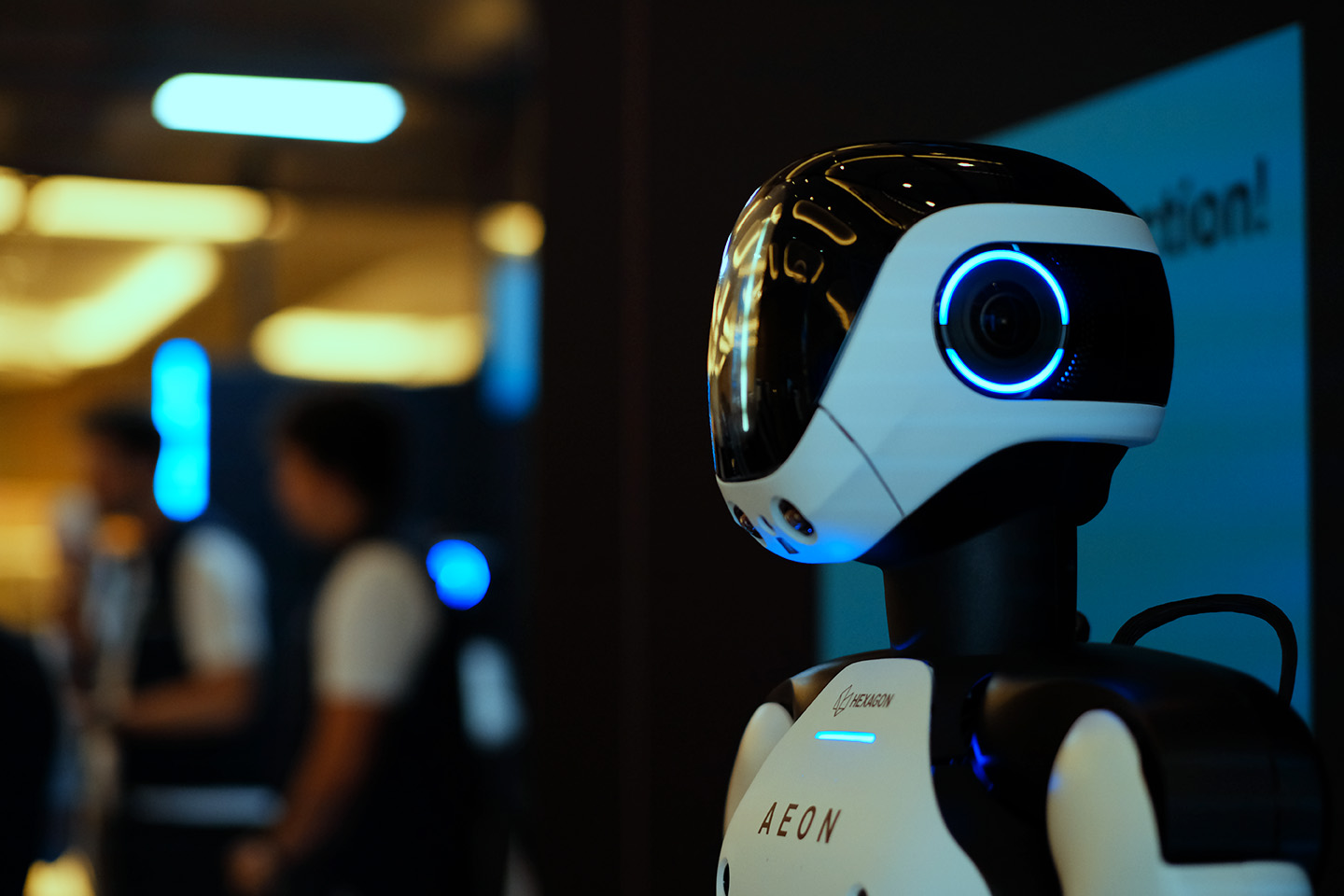
On the showfloor, the most popular selfie corner was next to the humanoid robot AEON, the product of Hexagon's newly formed Robotics division. The company explains, "AEON combines Hexagon’s world-class sensor suite with advanced locomotion, AI-driven mission control, and spatial intelligence to deliver exceptional agility, versatility, and awareness."
The Robotics division is led by Arnaud Robert, "a global strategic leader with 25 years of experience and a deep background in AI," according to the Hexagon press announcement.
Robert believes robots should be versatile and adaptable. "For example, the same robot should be able to move boxes around the factory, or inspect an automotive part ... One day it needs to be sorting small pieces, screws, bolts, which require high dexterity. And the next day, it needs to sort large parts, bulky parts from the engine," he said.
Hexagon's example is AEON, a humanoid robot capable of mimicking its human trainer's gestures, movements, and actions.
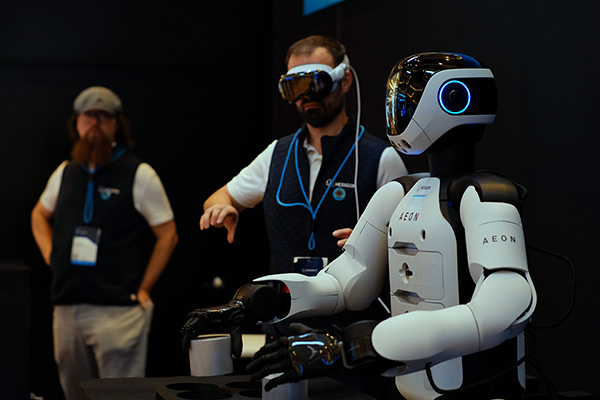
If Hexagon's robotic future vision sounds vaguely familiar, it's because it echoes many of what NVIDIA CEO Jensen Huang has said in his keynotes. The two companies also collaborated on the creation of AEON.
Hexagon used NVIDIA's AI supercomputers to train and fine-tune the robot's foundational behavior models; the NVIDIA Omniverse 3D simulation platform to test and optimize them using real and synthetic data; and NVIDIA IGX Thor robotic computers to run the programs.
According to NVIDIA, to develop humanoid robots, three accelerated computer systems are required:
"Manufacturers like Foxconn or logistics companies like Amazon Robotics can orchestrate teams of autonomous robots to work alongside human workers and monitor factory operations through hundreds or thousands of sensors," NVIDIA said.
Stephen Graham, Executive VP and GM of Nexus, Hexagon's cloud-based collaboration platform, noted, "It's important to note that AI cannot replace people. Manufacturing is fundamentally a human-centric activity. Engineers are making decisions on the tradeoffs between performance, costs, sustainability, and a number of competing priorities. These decisions have to be made by people. AI can assist in improving productivity and maintaining consistency."
During Hexagon LIVE, Hexagon released its annual Advanced Manufacturing Report, authored by the analyst firm Forrester.
"Right now, one word captures the sentiment: tariffs. But that’s just the crest of a much larger wave. With the constant threat of supply chain
shocks, mounting time to market pressures and the ongoing skills crunch, the industry is navigating constant turbulence," said Andreas Renulf, President, Hexagon Manufacturing Intelligence (MI).
The 50-page report is based on a survey of 1,000 respondents, spanning the electronics, healthcare, automotive, aerospace, and energy industries. Ninty percent of the respondents believe AI investment can help them gain a competitive advantage; and 39% of the C-level executives list agility as the top priority.
Presenting the findings at the conference, Paul Miller, VP and Principal Analyst, Forrester, identified the automation triangle as the emerging trend. "There is hardware automation. That's robots like AEON. And then software automation. So AI, machine learning, robotic process automation and the likes. And then people--the human workforce. The reality is that almost every task for years to come will be some combination of these three."
Some tasks, Miller pointed out, are better left to the robots. " The dull, the dirty, the dangerous. These are better done by an AI agent or a machine learning algorithm. Some tasks are more complex, more unpredictable, might require some compassion. Those kinds of tasks are better done by a person."
The report also reveals, "98% perceive value in digital twin, yet 90% report at least one barrier: real-time measurement is a huge capability blind spot." Miller noted the bi-directional feedback loops between the physical and the digital is an essential component of digital twins. "Without these, the thing you're talking about is not a digital twin at all. It's a pretty picture, a visualization," he said.


Hexagon is considered a global leader in measurement technologies. The company aims to bridge the physical and digital worlds with solutions in discrete manufacturing, reality capture, and positioning solutions.

Accelerating Your Journey to Smarter Industrial Facilities: Design
Transform your design processes for this new digital world by identifying efficiencies that can be gained that can help improve project delivery and overall quality in your projects.

Kenneth Wong is Digital Engineering's resident blogger and senior editor. Email him at [email protected] or share your thoughts or suggestions at digitaleng.news/facebook.
Follow DE






About Us · Contact Us · Editorial Team · Advertising · Privacy Policy · Subscriber Services · © 2026 Digital Engineering 24/7 · Peerless Media