Helping design and engineering professionals discover, evaluate and specify technologies and processes that shorten the design cycle and enable success.


Alert!
Digital Engineering ceased publication on July 1, 2026. This website remains available as an archive of engineering content.
For inquiries or information, please email [email protected].

Digital Engineering April 2026
In the latest issue of Digital Engineering, we take a look at the latest innovations in design for additive manufacturing, including the use of natural language inputs, social media cosplayers, and AI integration. The issue also includes a feature…

January Special Focus Issue: Design for Additive
In this Special Focus Issue of Digital Engineering, learn about the latest advancements in design for additive manufacturing, including new software tools, additive in automotive, custom medical devices, and more.
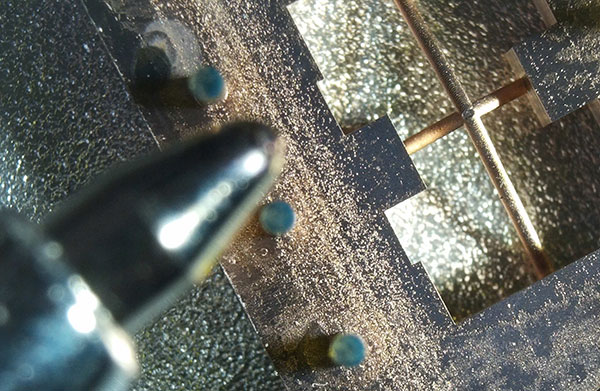
Horizon Microtechnologies has launched a suite of in-house processes that add material and functionality to a microstructure, all developed to work with a range of template materials and template shapes, the company notes. The company produces parts from a template, but its technologies make the final parts more functional than the original template in a variety of ways.
The technologies are intended as a post-printing treatment for micro-AM derived templates. Horizon is now adding copper metal coatings to polymer micro-AM and other micro structures.
“Our initial focus is on copper coatings, as this opens up an array of application possibilities for companies wishing to add functionality to micro-AM templates," says Andreas Frölich, CEO at Horizon. "Copper coatings can offer significant benefits for microfabricated or micro-additive manufactured parts, but there are several challenges and problems associated with current coating solutions that Horizon has addressed to ensure the successful application of the copper.”
The addition of copper coatings to micro-AM or other 3D microfabricated templates can offer advantages such as improved electrical and thermal conductivity.
When working with 3D polymer templates, existing copper coating technologies are challenged by issues like non-uniform deposition of the copper, adhesion of the copper to the substrate, low deposition rates or achieving deposition.
“Any technique for deposition of copper coatings requires precise control over process parameters, for example, temperature, pressure or flow rates, to achieve uniform and defect-free coatings," Frölich continues, "This can be particularly challenging when working with complex part geometries, and again is an area where Horizon has focused its efforts. One of the key reasons why companies seek to use micro-AM parts is because micro-AM opens up design freedom and allows the creation of complex geometries, and so any copper coating technology must be agnostic to complexity in order to be attractive for use with micro-AM parts.”
Horizon’s coatings are typically in the 1-2 micron thickness range. The company’s process can also coat internal channels and undercuts to some degree, the channel’s aspect ratio being the limiting factor now rather than the absolute length.
Through Horizon’s technology, the functional advantages of copper can be married with the design flexibility of micro-AM. The technology is suited to applications where the use of bulk copper is not required and would be technically impossible or uneconomic.
“Copper coatings can significantly improve the surface properties of micro fabricated parts by adding wear resistance, lubricity and hardness," says Frölich. "The most important use case for the coatings is when highly conductive surfaces are required. Again, of significant importance, (and if designed well) our copper coating can be used not just to coat an entire micro-part, but to selectively coat features on a given template, creating several independent metal features for interconnects, vias, etc.”
The key application areas for copper coated micro-AM and microfabricated templates are those that require high precision, complex geometries, and advanced materials properties, such as high electrical conductivity, according to Horizon. Opportunities exist in the production of micro-electronic devices such as free-form printed circuit boards, interposers and interconnects; micro-sensors; miniaturized biomedical devices (such as implantable sensors); drug delivery systems; lab-on-a-chip systems, micro-reactors, and microfluidic sensors; and MEMS actuators and transducers.
Sources: Press materials received from the company and additional information gleaned from the company’s website.


DE's editors contribute news and new product announcements to Digital Engineering. Press releases may be sent to them via [email protected].
Follow DE






About Us · Contact Us · Editorial Team · Advertising · Privacy Policy · Subscriber Services · © 2026 Digital Engineering 24/7 · Peerless Media