Helping design and engineering professionals discover, evaluate and specify technologies and processes that shorten the design cycle and enable success.


Sponsored

May 2026 Special Focus: Artificial Intelligence in Design and Simulation
In this Special Focus Issue, learn about the latest developments in the integration of artificial intelligence into engineering workflows.

April 2026 Special Focus Issue: Generative Design
In this Special Focus Issue, Digital Engineering takes a look at how generative design solutions can be used across different types of design problems and with a variety of manufacturing approaches to accelerate design space exploration, and…
Industrial machinery end-customers want customized products delivered quickly. To meet this demand requires sophisticated machine designs. The need for high-level customization with superior machine complexity drives manufacturers to support a global machine design to implement manufacturing strategies. In addition, manufacturers can enhance their machine validating process with technological innovations like virtual simulation and commissioning to address complex customer demands efficiently.
Virtual machine simulation and commissioning is the process of validating the software code (PLC/HMI/SCADA) in the virtual world before it deploys on the factory floor. As software drives machines, it becomes even more complex. Therefore, it is essential to simulate the code running on a machine's virtual twin to generate substantial dividends in time and resources. Virtual simulation and commissioning validate the PLC (programmable logic controller) software in a managed environment, an integral part of the modular product development strategy. Then machine builders can perform the simulation upfront and link the software to the modules, merging the final code seamlessly on an individual customer-specific machine.
Many software integrations and safety factors are essential to run a machine, so a customer must test it physically. Accordingly, virtual simulation and commissioning are ideal for turning a machine on and performing real commissioning. Then there is significantly less pressure for the machine builder and its customers. In addition, this process collaborates the engineering upfront in the design process to further reinforce the interdependency of all virtual simulation and commissioning disciplines.

Critical elements of the virtual simulation and commissioning process include the following:
These essential processes foster an environment that results in considerable benefits. Consequently, the demand for virtual simulation and commissioning, in combination with the digital twin, provides substantial advantages:
Additionally, virtual simulation and commissioning benefits create outstanding efficiency on the shop floor to achieve higher speeds and excellent reliability—a 20% improvement in machine shop or operations capacity. This efficiency saves valuable time previously spent in physical validation, verification and commissioning.
However, the positive aspects of innovative technologies come with their accompanying challenges, including validating third-party equipment integration, which requires the need to bring disparate systems and code together cohesively. Secondly, robotic integrations require connecting that code into the PLC for better efficiency. Lastly, logistics automationprovides substantial proficiency by orchestrating multiple interfaces simultaneously.
Many use cases detail the benefits of virtual simulation and commissioning. As a result, some noteworthy companies are witnessing notable improvements.
Tronrud Engineering develops, manufactures and supplies innovative machines and equipment to users. Using a new machine's digital twin allows the designers, engineers and programmers to work concurrently while continuously sharing their knowledge. This process substantially compresses commissioning and engineering time.
“By working on the design, mechanical components and programming simultaneously, we can drastically reduce the time to market. In another project, this approach allowed us to save about 20 percent or two months,” says Erik Hjertaas, General Manager Packaging Technology at Tronrud Engineering.
In response to the parallel execution of development steps in an interdisciplinary team, Tor Morten Stadum, PLM Manager at Tronrud Engineering, states, “We shortened the design phase by about 10 percent and commissioning by 20 to 25 percent.”
Also, Eisenmann, a leading global provider of industrial solutions in southern Germany, plans and builds made-to-measure manufacturing, assembly and enterprises worldwide. They have deployed highly flexible distribution plants that are energy- and resource-efficient for more than 65 years. Also, they’re gaining the benefits of virtual modeling, simulation and commissioning.
“The simulation model we create with Plant Simulation is often part of the deliverable to our customers. Many of them also use Plant Simulation themselves, so they know how to run the simulation and change the needed parameters. This is a big benefit for them because they get a virtual model of the physical line,” says Dr. Heiner Träuble, Simulation Expert Automotive Paint Systems Eisenmann.
“We are very pleased with the discrete event simulation capabilities we have developed in Eisenmann throughout the years, especially our use of Plant Simulation,” says Sebastiano Sardo, Senior Vice President, Eisenmann Conveyor Systems.
Using the Xcelerator portfolio, a suite of services from Siemens Digital Industries Software Solutions helps manufacturers create a comprehensive digital twin. It also integrates simulation within the machine design to be flexible, capable and adaptable. Connected machines, which can communicate with other machines, extend their capabilities through software-driven changes. This value is essential for modern manufacturers to maximize the productivity of the end-user environment.
Companies need a digital solution that crosses all aspects of a machine manufacturer’s product and production process to connect, adapt, predict and extend the machines of tomorrow, today.
Rahul Garg is the Vice President for Industrial Machinery & SMB Program, responsible for defining and delivering key strategic initiatives and solutions and global business development. He and his team are responsible for identifying key initiatives and developing solutions for the industry while working closely with industry leading customers and providing thought leadership on new and emerging issues faced by the machinery industry. Rahul’s experience and insight are derived from 25-year career delivering software-based solutions for product engineering and manufacturing innovation for the global manufacturing industry, spanning a career in R&D to program management, sales and P&L management and having focused exclusively on the industrial machinery and heavy equipment industry since 2007.


Simcenter™ software, from Siemens Digital Industries Software, uniquely combines system simulation, 3D CAE and test to help you predict performance across all critical attributes earlier and throughout the entire product lifecycle. By combining…
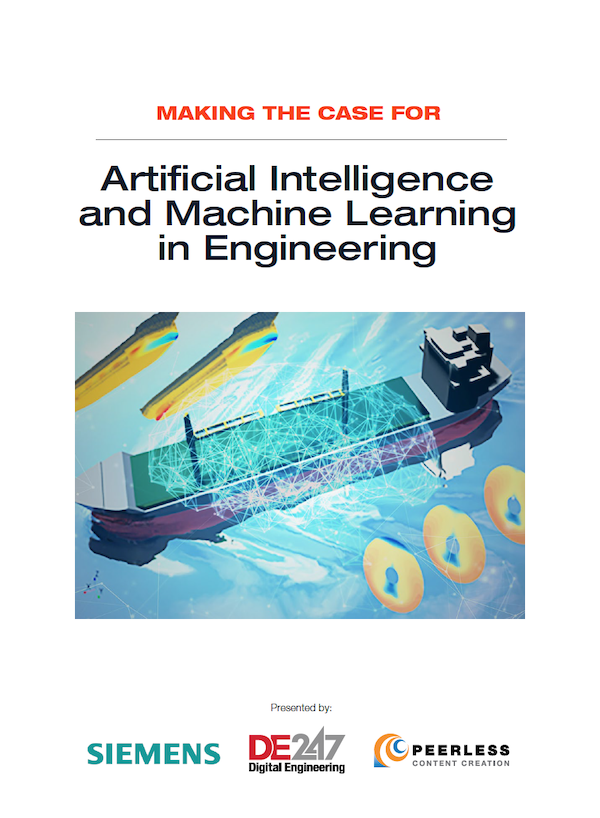
Making the Case for Artificial Intelligence and Machine Learning in Engineering
In this paper, Siemens Digital Industries Software and Digital Engineering will provide an overview of how AI/ML-enabled software can improve design workflows, while also addressing common questions and concerns around implementing this technology in an engineering organization.

Join over 90,000 engineering professionals who get fresh engineering news as soon as it is published.






About Us · Contact Us · Editorial Team · Advertising · Privacy Policy · Subscriber Services · © 2026 Digital Engineering 24/7 · Peerless Media