Helping design and engineering professionals discover, evaluate and specify technologies and processes that shorten the design cycle and enable success.


Alert!
Digital Engineering ceased publication on July 1, 2026. This website remains available as an archive of engineering content.
For inquiries or information, please email [email protected].

Digital Engineering April 2026
In the latest issue of Digital Engineering, we take a look at the latest innovations in design for additive manufacturing, including the use of natural language inputs, social media cosplayers, and AI integration. The issue also includes a feature…

January Special Focus Issue: Design for Additive
In this Special Focus Issue of Digital Engineering, learn about the latest advancements in design for additive manufacturing, including new software tools, additive in automotive, custom medical devices, and more.
One of the biggest challenges to widespread AM adoption is complexity—the struggle to integrate different software and hardware elements as part of a semi-turn-key solution has turned many a company away from serious 3D printing use.
In order to turn that tide and make it easier to scale AM, HP has recently struck partnerships with Autodesk and Materialise to integrate their software with its 3D printer hardware as part of an integrated solution.
HP plans to bundle Autodesk Fusion with the HP Multi Jet Fusion and Metal Jet printers to create an integrated design and manufacturing solution. The idea is to make it easier for engineers and designers to practice design for AM (DfAM) principles from the very beginning of the process, leveraging an integrated workflow to create custom designs that take advantage of 3D printing’s unique capabilities for organic, lightweight shapes and consolidation of parts. By creating this hardware/software bundle, engineers gain a turnkey solution for large-scale parts production without the heavy lifting typically associated with integrating disparate technologies in a combined system.
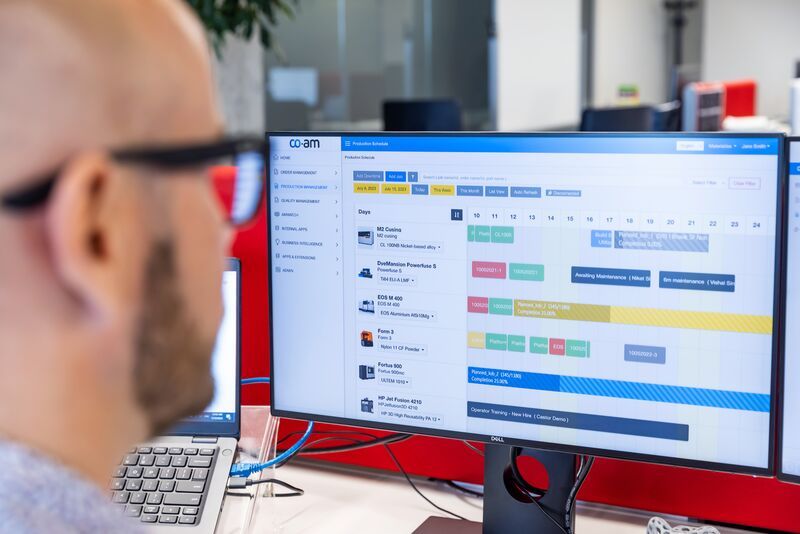
HP’s partnership with Materialise charts similar ground, but with a focus on helping companies scale for industrial-ready AM production. The partners are integrating HP’s Multi Jet Fusion and Metal Jet AM technologies into Materialise’s CO-AM cloud-based platform designed for scaling AM workflows. The resulting end-to-end manufacturing solution is designed for productivity and scale.
“To scale additive manufacturing, the industry is in need of printers that are designed for high productivity coupled with an integrated end-to-end workflow solution,” says Arvind Rangarajan, global head of software and data for HP Personalization and 3D printing. While manufacturers recognize the value of AM, they’ve encountered challenges as they onboard the technology, including that the speed of 3D printing processes don’t hold up to volume production or that AM processes don’t integrate well with existing manufacturing technologies, Rangarajan explains.
The seamless connectivity between HP printers and Materialise CO-AM enables users to create workflows that improve traceability, quality control, and machine utilization. The combined solution lets enterprises optimize 3D print job management to track planned and actual printer activities and to optimize machine time. CO-AM tracks critical process data on build status, materials usage, and machine sensor data; the data can be stored in log files of 3D printed jobs to enhance traceability and quality control in line with what’s required for continuous production and real-time machine monitoring. HP process data from the Powder Management Station, Curing Station, and Powder Removal Station can also be connected to CO-AM to aid in more streamlined post-processing of metal parts.
Materialise’s Magics data and build preparation software is also part of the mix, connecting easily to HP 3D printers via the HP Build Processor. This ensures users can prepare more effective 3D printing jobs, including automating repetitive tasks and use of nesting for maximizing the number of parts printed per job, aiding in machine utilization.
“Manufacturers are increasingly using 3D printing for end-use parts instead of solely in the protyping and design phase,” added Bart Van der Schueren, Materialise’s CTO. “This partnership will help drive this shift by supporting more efficient, repeatable volume production.”
This video provides a deep dive on how Materialise CO-AM enhances the manageability of 3D printing workflows.

Materialise is headquartered in Leuven, Belgium and has branches worldwide. We've been playing an active role in the field of Additive Manufacturing (AM) since 1990. In addition to having the largest single-site capacity of AM equipment in…

Beth Stackpole is a contributing editor to Digital Engineering. Send e-mail about this article to [email protected].
Follow DE






About Us · Contact Us · Editorial Team · Advertising · Privacy Policy · Subscriber Services · © 2026 Digital Engineering 24/7 · Peerless Media