Helping design and engineering professionals discover, evaluate and specify technologies and processes that shorten the design cycle and enable success.


Alert!
Digital Engineering ceased publication on July 1, 2026. This website remains available as an archive of engineering content.
For inquiries or information, please email [email protected].

May 2026 Special Focus: Artificial Intelligence in Design and Simulation
In this Special Focus Issue, learn about the latest developments in the integration of artificial intelligence into engineering workflows.

April 2026 Special Focus Issue: Generative Design
In this Special Focus Issue, Digital Engineering takes a look at how generative design solutions can be used across different types of design problems and with a variety of manufacturing approaches to accelerate design space exploration, and…
Printed and flexible sensors constitute the largest printed electronics market outside of displays, according to IDTechEx. The company forecast that the market for fully printed sensors will reach $4.9 billion by 2032. This growth is despite the sustained displacement of its largest market—printed glucose test strips—with continuous glucose monitoring (CGM) approaches. Market growth of the overall category is enabled by the rise of new applications and technologies.
The new report from IDTechEx, "Printed and Flexible Sensors 2022-2032: Technologies, Players, Markets," explores the printed and flexible sensor landscape covering established and emerging technologies with a broad range of applications. Specifically, the report covers:
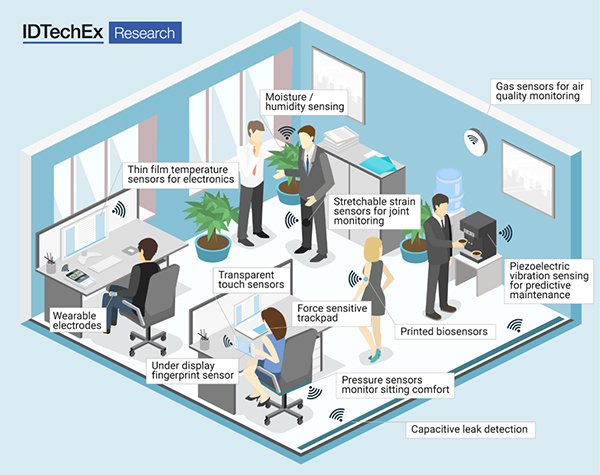
Printed sensors span a range of technologies and applications, ranging from image sensors to wearable electrodes. Each sensor category seeks to offer a value proposition over the incumbent technology, with distinct technological and commercial challenges en route to widespread adoption.
Despite this diversity, there are multiple factors that are driving the adoption of many types of printed/flexible sensors. Most important is the increasing adoption of IoT and Industry 4.0 since they will require extensive networks of often wirelessly connected low-cost and unobtrusive sensors. Additionally, the thin-film form factor and conformality of printed/flexible sensors enable them to be incorporated within smaller devices, providing increased freedom for designers to differentiate their products and potentially new use cases.
Sources: Press materials received from the company and additional information gleaned from the company’s website.


DE's editors contribute news and new product announcements to Digital Engineering. Press releases may be sent to them via [email protected].
Follow DE






About Us · Contact Us · Editorial Team · Advertising · Privacy Policy · Subscriber Services · © 2026 Digital Engineering 24/7 · Peerless Media