Helping design and engineering professionals discover, evaluate and specify technologies and processes that shorten the design cycle and enable success.



Digital Engineering April 2026
In the latest issue of Digital Engineering, we take a look at the latest innovations in design for additive manufacturing, including the use of natural language inputs, social media cosplayers, and AI integration. The issue also includes a feature…

January Special Focus Issue: Design for Additive
In this Special Focus Issue of Digital Engineering, learn about the latest advancements in design for additive manufacturing, including new software tools, additive in automotive, custom medical devices, and more.
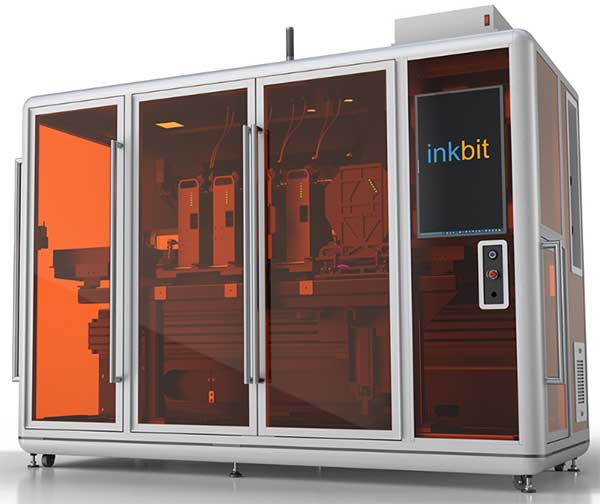
Inkbit, a company that has built a 3D printer driven by vision-based feedback control, has launched its Additive Manufacturing System with Inkbit Vista. The closed-loop feedback 3D printing ecosystem offers a platform based on scalable inkjet deposition and 3D machine vision.
Inkbit Vista features the Vision-Controlled Jetting solution and multi-material design software, enabling manufacturers to bridge the gap between prototyping and full-scale production, company says.
Vision-Controlled Jetting (VCJ) takes additive manufacturing to production by enabling real-time, in-process voxel-level control to meet the reliability and performance demands of volume manufacturing. This technology converges advanced computational techniques with a scalable hardware architecture and materials chemistries inaccessible to incumbents. VCJ was developed at MIT and is protected by a strong IP portfolio exclusively licensed to Inkbit.
VCJ enables development of end-use products with high-performance polymers by:
“We are thrilled to launch Inkbit’s Additive Manufacturing System and offer a unique, rapidly deployable 3D printing solution to companies looking to adopt digital manufacturing,” says Davide Marini, co-founder and CEO at Inkbit. “Today, engineers are often using 3D printing technology to make prototypes, but limitations in materials and high costs make end-use product production difficult. At Inkbit, we’re on a mission to disrupt that notion and create a technology that provides fast printing capabilities with unmatched design freedom and reliability for even the most demanding applications and environments.”
Inkbit was spun out of the Computer Science and Artificial Intelligence Laboratory (CSAIL) at MIT in 2017 and has since raised $15 million in equity investments from investors such as Stratasys, DSM Venturing, Ocado, 3M, IMA and Saint-Gobain. Inkbit also received funding from DARPA and NSF for the development of its core technology and applications in the medical field.
Inkbit Vista is available for pre-order today.
Sources: Press materials received from the company and additional information gleaned from the company’s website.


DE's editors contribute news and new product announcements to Digital Engineering. Press releases may be sent to them via [email protected].
Follow DE
Join over 90,000 engineering professionals who get fresh engineering news as soon as it is published.






About Us · Contact Us · Editorial Team · Advertising · Privacy Policy · Subscriber Services · © 2026 Digital Engineering 24/7 · Peerless Media