Helping design and engineering professionals discover, evaluate and specify technologies and processes that shorten the design cycle and enable success.





May 2026 Special Focus: Artificial Intelligence in Design and Simulation
In this Special Focus Issue, learn about the latest developments in the integration of artificial intelligence into engineering workflows.

Design & Simulation Software Guide 2025
In this Special Issue, Digital Engineering presents its second annual guide to design and simulation software vendors.
This week, several developers behind Intel Embree became part of the Hollywood crowd.
Sven Woop, Carsten Benthin, Attila Afra, Manfred Ernst, and Ingo Wald -- part of the team behind Intel Embree -- received the Scientific and Technical Awards from the Academy of Motion Picture Arts and Sciences for "early research and technical direction of the Intel Embree Ray Tracing Library."
"For the past decade, the Intel Embree Ray Tracing Library has provided a high-performance, industry-leading, CPU-based ray-geometry intersection framework through well-engineered open source code, supported by a comprehensive set of research publications. It has become an indispensable resource for motion picture production rendering," wrote the Academy.
Embree is a library of open-source ray-tracing kernels developed at Intel. As a component of the oneAPI Rendering Toolkit, Embree is optimized for specific Intel CPUs. The company's plan is "to map all the Intel oneAPI Rendering Toolkit libraries to take advantage of future Intel Xe GPUs using a platform XPU approach (using cooperative computing with CPUs and GPUs)," explained Intel PR.
The list of engineering applications that have incorporated the Embree and OSPRay (which incorporates Embree) includes AutoCAD, Autodesk Revit, Autodesk 3ds Maya, Ansys EnSight, Siemens Star CCM+, Corona from Chaos, and more.
oneAPI is Intel's countermeasure to GPU maker NVIDIA's CUDA, a GPU-based programming environment. Intel describes oneAPI as "a unified programming model for CPUs, GPUs, FPGAs, and other accelerators."
Intel's latest initiative to broach the GPU market, dominated by NVIDIA and AMD, is the Intel Xe GPU line. Intel's earlier attempt at a general purpose GPU product with the Intel Larrabbee architecture fizzled out in 2010.

Intel's innovation in cloud computing, data center, Internet of Things, & PC solutions is powering the smart and connected digital world we live in.
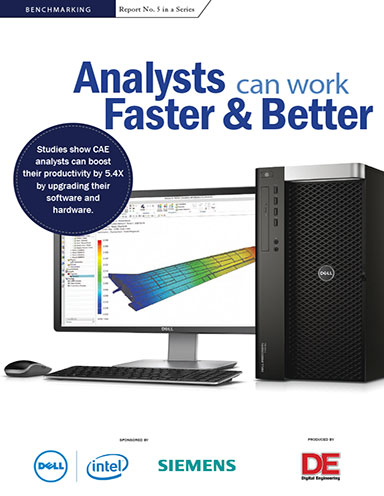
Benchmarking Report 5: Analysts Can Work Faster & Better
As the benchmarking results in this report show, you can slash the time spent on certain simulation runs by more than 81% when you upgrade to the latest Dell workstation technology and Siemens Simcenter simulation software, compared to using older hardware and software.

Kenneth Wong is Digital Engineering's resident blogger and senior editor. Email him at [email protected] or share your thoughts or suggestions at digitaleng.news/facebook.
Follow DE
Join over 90,000 engineering professionals who get fresh engineering news as soon as it is published.






About Us · Contact Us · Editorial Team · Advertising · Privacy Policy · Subscriber Services · © 2026 Digital Engineering 24/7 · Peerless Media