Helping design and engineering professionals discover, evaluate and specify technologies and processes that shorten the design cycle and enable success.


Alert!
Digital Engineering ceased publication on July 1, 2026. This website remains available as an archive of engineering content.
For inquiries or information, please email [email protected].

May 2026 Special Focus: Artificial Intelligence in Design and Simulation
In this Special Focus Issue, learn about the latest developments in the integration of artificial intelligence into engineering workflows.

April 2026 Special Focus Issue: Generative Design
In this Special Focus Issue, Digital Engineering takes a look at how generative design solutions can be used across different types of design problems and with a variety of manufacturing approaches to accelerate design space exploration, and…
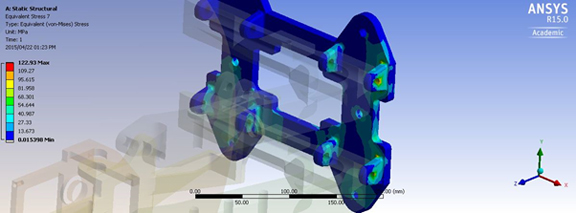
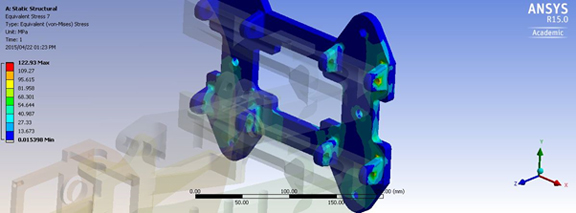 UKZN students conducted FEA on the solar car's mounting plate to verify the maximum loading conditions.
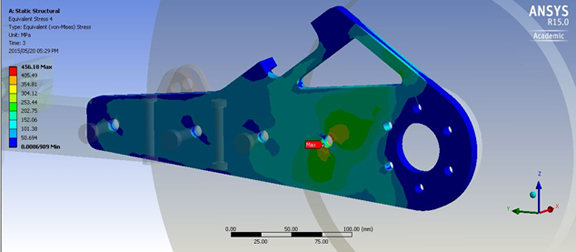 UKZN students' FEA results on the solar car's motor mounting plate showing maximum loading conditions.
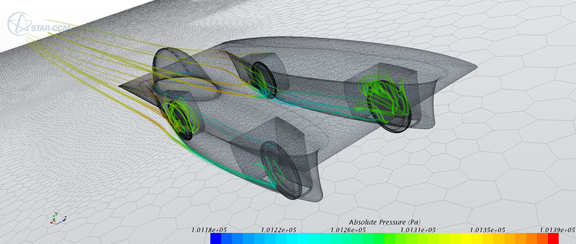 The students conducted CFD on the shape of the car to predict its aerodynamic performance.
Rolling blackouts are part of life's regular rhythm in KwaZulu-Natal. At its official webpage, Durban, the largest city in the South African province of KwaZulu-Natal, publishes a schedule of planned blackouts, part of the municipality's "load shedding" to cope with peak electricity demands. In 2014, one such blackouts in nearly robbed the University of KwaZulu-Natal's (UKZN) solar car team of their victory in the South African solar challenge Sasol.
Kirsty Veale, a UKZN PhD student and the solar car team's comanager, recalled, "Our car was beautiful! We drove it around for a few days. It worked as it was supposed to. But just before the race, there was a rolling blackout in the area we were staying at, so we couldn't charge our battery."
Once the race begins, the competing cars are no longer allowed to recharge their on-board batteries. They must then rely solely on solar power to finish the race. So starting the race with a fully charged battery is essential. "Our team of 10 people had to pack up our entire workshop -- tools, clothes, the solar car, and the equipment -- and drove to another town to find a plug so we could charge our car," Veale said.
The car was finally charged at 3 AM, three hours before the race, but the team soon ran into a bigger problem. "One of our students, who was by now obviously sleep-deprived, turned on the car in the wrong sequence and blew it up."
Though the car didn’t literally blow up, the error rendered the vehicle inoperable. The team spent the first day of the race rewiring the car. Despite these two unforeseen catastrophes, the team still finished first in the South African category and third in the overall race.
The team's car in 2014 was dubbed iKlwa, after the short-shaft spear invented by Shaka Zulu. The car was designed in Autodesk Inventor CAD software and optimized with simulation programs from ANSYS and CD-adapco.
Team member Saien Rugdeo, a mechanical engineering student with Finite Element Analysis (FEA) expertise, said, "Contemporary mechanical design practice is simulation-led design, so we’re moving away from designing first and experimental testing later. We use simulation from the beginning so we would use less physical testing and prototyping. We feel that, with simulation, we get an acceptable rate of accuracy to make best engineering decisions in the concept phase."
Once the vehicle's basic geometry has been defined in Inventor, it was imported to ANSYS Workbench for static structural analysis. "The car currently has two main shrouds [front and rear], like a catamaran," said Rugdeo. "But that was not always the case. First we toyed with the idea of a three-shroud chassis. We also looked at a five-shroud design, with each wheel in its case. Based on iterative process and computer fluid dynamics (CFD) analysis, we determined the two-shroud shape is the best [most aerodynamic] design." The team's CFD simulations were completed by Christopher Lawrence, a UKNZ Master's candidate who has been working on improving the aerodynamics of the car as part of his research.
One of the stumbling blocks in structural analysis for the team was the suspension system. Veale said, "It's a very unique type of suspension, so it was difficult to know what the loading conditions were and how to constraint it. It's not what you'd see in a typical car, so if we asked someone else for help, they often got confused. But once we figured out how the loads should be applied, it worked out quite nicely."
Early structural analysis allowed the team to identify high-stress areas so so they could add more materials to strengthen the vulnerable components.The car's monocoque shell is made of carbon fiber, which resulted in a lighter vehicle. In the first incarnation, the team didn't get the chance to perform composite analysis, but they might for future versions.
Sandeep Sovani, ANSYS software's director of global automotive industry, observed, "With composite, they’re anisotropic, so they’re different from traditional metal. Some composite information comes preloaded in ANSYS software. Others have to be supplied by the users." Sovani thinks the team could redesign their vehicle to be even lighter. "Looking at their mounting brackets, I think they could have used topology optimization features in our software to shave off even more weight and materials. The metal parts in particularly are good candidates," he added.
The team's 2014 vehicle iKlwa was a descendant of the first car, Apalis. In July, the UKZN solar car team unveiled iKlwa's latest successor, dubbed Hulamin. The students are once again packing up their car to get on the road. Hulamin will be racing in The 2015 Bridgestone World Solar Challenge in Australia (October 18-25).
Kirsty Veale and Saien Rugdeo discussed the solar car project in a recent ANSYS webinar. You can listen to it here.


Kenneth Wong is Digital Engineering's resident blogger and senior editor. Email him at [email protected] or share your thoughts or suggestions at digitaleng.news/facebook.
Follow DE






About Us · Contact Us · Editorial Team · Advertising · Privacy Policy · Subscriber Services · © 2026 Digital Engineering 24/7 · Peerless Media