Digital Engineering 24/7

Helping design and engineering professionals discover, evaluate and specify technologies and processes that shorten the design cycle and enable success.


LMS International's Simulation Software Solutions on Display at SAE 2009

Software aids powertrain design, simulation, and analysis.

By DE Editors  

March 19, 2009

By DE Editors

LMS International’s Simulation Software Solutions on Display at SAE 2009
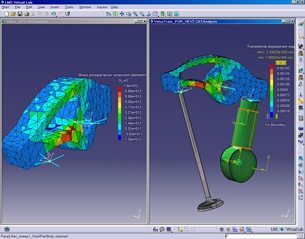
Valvetrain durability screen shot from Virtual.Lab software

LMS provides a combination of 1-D and 3-D simulation solutions that are made to match diesel powertrain challenges. The software suite, including Virtual.Lab Motion, Acoustics and Durability solutions, together with Imagine.Lab Internal Combustion Engine, Fluids Systems, Powertrain Transmission, and Vehicle Thermal Management solutions, help to design powertrain architectures that reduce CO2 emissions and economize fuel while maintaining sound quality, reliability, and driving comfort. LMS simulation solutions make it possible to study powertrain systems from sub-systems and components to the global engine architecture.

Simulation possibilities include:

  • Cranktrain, valvetrain, timing chain: Simulate complex dynamic engine performance and accurately predict internal loads for determining fatigue life, vibrations, and engine radiated noise. Study any kind of advanced hydraulic valvetrain architecture, from variable valve timing and cam phasing to electro-hydraulic variable valve actuation (EHVT) systems.
  • Fuel injection:  Design HP and LP injection components and systems (pump, rails, injectors) to predict injection flow rates and shapes, pressure losses, and assess thermal constraints.
  • Engine thermal management: Rapidly study influence of new heat management strategies and engine architectures on warm-up, fuel consumption and pollutant emissions. Assess the overall energy balance of an engine by considering thermal interactions between the lubrication and cooling systems, the thermal engine, the combustion chamber, and the intake and exhaust pipes.
  • After-treatment and exhaust systems: Explore and optimize architectures for engine emissions (urea injection system, interactions and cross influences between the engine and its environment. Simulate shell radiation of mufflers. Perform durability seam weld analysis.
  • Gearbox and driveline: Study the global behavior of the entire powertrain architecture, from low to high frequencies (> 40 Hz), by accessing driveline, engine, and transmission models and components, and focusing on comfort, performance, losses and NVH issues with Imagine.Lab Powertrain Transmission solutions.
  • Controls integration: Link Imagine.Lab AMESim plant model with control system models thanks to various interfaces and real-time libraries

LMS will be at SAE 2009 in Detroit, April 20 to 23.

For more information, visit LMS North America.

Sources: Press materials received from the company and additional information gleaned from the company’s website.


 

About DE Editors

DE Editors

DE's editors contribute news and new product announcements to Digital Engineering. Press releases may be sent to them via [email protected].

Follow DE

on Facebook
on Linkedin

Related Topics

Simulate   News   All topics
 

Subscribe

Subscribe to our FREE magazine, FREE email newsletters or both!

Join over 90,000 engineering professionals who get fresh engineering news as soon as it is published.

Subscribe today


From our Sponsors

Meltio Takes Metal Additive to the Next Level
Meltio's DED technology enables industries to tailor and customize their solutions to create & repair metal parts.
Easing the Transition from ETO to CTO with Configuration Lifecycle Management
Manufacturers are discovering that the Configure-to-Order (CTO) model provides significant benefits when it comes to customization.
Siemens + Altair = The Next Chapter in Design and Simulation
With its acquisition of Altair, Siemens creates a unified simulation portfolio combining generative design with high-performance computing and AI workflows.