Helping design and engineering professionals discover, evaluate and specify technologies and processes that shorten the design cycle and enable success.



Digital Engineering April 2026
In the latest issue of Digital Engineering, we take a look at the latest innovations in design for additive manufacturing, including the use of natural language inputs, social media cosplayers, and AI integration. The issue also includes a feature…

January Special Focus Issue: Design for Additive
In this Special Focus Issue of Digital Engineering, learn about the latest advancements in design for additive manufacturing, including new software tools, additive in automotive, custom medical devices, and more.
Lockheed Martin, a pioneer leveraging additive manufacturing technology, decided to push the boundaries once again, this time as part of design project to make more efficient use of space while increasing the satellite's payload. Because the process would require testing many assembly configurations and producing several simulations to validate the various design changes, the Lockheed team was interested in alternative approaches to traditional manufacturing methods—particularly around the design and function of the satellite's giant fuel tanks.
The tanks—one measuring 6.75x3.8x3.8 ft. and the second at 3.8x3.8x 3.8 ft. — would take over six months to produce to the tune of around $250,000 with traditional machining and CNC methods. That was not a realistic timetable given the deadlines Lockheed was facing and because of the high costs.
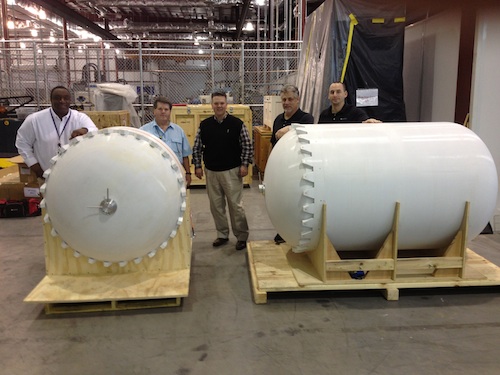 Lockheed Martin needed RedEye's machines and finishing capabilities to build tanks of this size. Image courtesy of RedEye.
While Lockheed Martin has a wealth of experience in 3D printing and some significant additive manufacturing horsepower on site in the form of three print shops stocked with Stratasys Fused Deposition Modeling (FDM) machines, among other systems, the team turned to Stratasys' RedEye AM services bureau arm and specifically, its aerospace team, for help on this project. Given the size of the fuel tanks and the precise tolerances necessary for their production, the project presented a challenge to Lockheed Martin's in-house additive manufacturing capabilities. Specifically, the part size, post processing requirements and project deadline were a bit more than its internal resources could handle. In addition, the team felt they could benefit from a deeper bench of 3D printing expertise, according to Joel Smith, RedEye's strategic account manager.
"They understand 3D printing and are one of the leading users of the technology in the aerospace and defense space, but even they were challenged by printing something that large," Smith explained. "When you see something that large that's 3D printed, it's really mind blowing."
Because of the tight tolerances, parts of the fuel tank had to be machined—another area where RedEye's expertise was invaluable.
"We actually built parts a little bit out of spec and then machined them into tolerance," Smith said. "Having those tight tolerances means you really have to understand the limitations of FDM. We understood there would be some challenges to maintaining a certain radius and we were able to leverage both FDM and traditional ways of machining and use both where it made sense."
RedEye also has deeper expertise and knowledge of finishing practices and cutting and bonding sections together as part of post-processing work, Smith said. For example, the team had to adapt along the way to meet the tight tolerances, in one case, altering the orientation of the exterior clocking rings that go around the tanks and increasing their wall thicknesses to increase inserts.
Each section of the tanks took 150 hours to build, but given RedEye's capacity, the team could handle building multiple sections simultaneously, aiding in meeting those tight delivery cycles and helping to keep costs in check. Leveraging AM capabilities for for this project allowed Lockheed Martin to build the fuel tanks for roughly half the cost of traditional machining, Smith said.
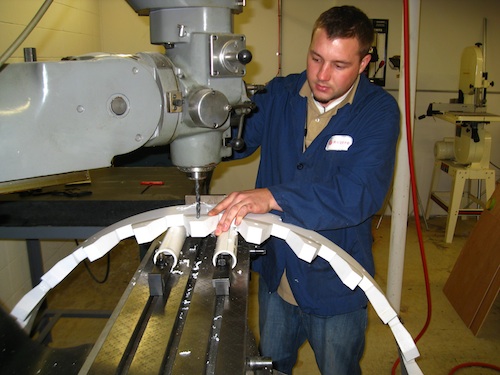 RedEye finishing services adding inserts to the 3D printed Lockheed Martin tank simulation rings. Image courtesy of RedEye.
"It was really a team effort," Smith said. "They understood the design and how it should work and we helped get through the process by understanding the parameters for FDM."
The project also has significance for other companies, both in the A&D sector as well as other industries.
"There are a lot of leaders in manufacturing that don't really understand the capabilities of AM in terms of reducing costs when prototyping, doing design validation, or decreasing lead times and getting product to market quicker," Smith said. "This is a proof point that AM can be leveraged effectively on some really pivotal parts and products."
To see the fuel tank 3D printing job in action, check out this video.


Beth Stackpole is a contributing editor to Digital Engineering. Send e-mail about this article to [email protected].
Follow DE
Join over 90,000 engineering professionals who get fresh engineering news as soon as it is published.






About Us · Contact Us · Editorial Team · Advertising · Privacy Policy · Subscriber Services · © 2026 Digital Engineering 24/7 · Peerless Media