Helping design and engineering professionals discover, evaluate and specify technologies and processes that shorten the design cycle and enable success.


Alert!
Digital Engineering ceased publication on July 1, 2026. This website remains available as an archive of engineering content.
For inquiries or information, please email [email protected].

Digital Engineering April 2026
In the latest issue of Digital Engineering, we take a look at the latest innovations in design for additive manufacturing, including the use of natural language inputs, social media cosplayers, and AI integration. The issue also includes a feature…

January Special Focus Issue: Design for Additive
In this Special Focus Issue of Digital Engineering, learn about the latest advancements in design for additive manufacturing, including new software tools, additive in automotive, custom medical devices, and more.
Nevertheless, Australian startup Aurora Labs is willing to take its chances with the Kickstarter launch of its S1 metal 3D printer. For the introductory price of A$4,499 (just under $4,000 US), you or your small business can buy a metal AM system. Even with the steeper investment cost, Aurora Labs might just make its goal of A$100,000. Just a day in and it’s already approaching the halfway mark.
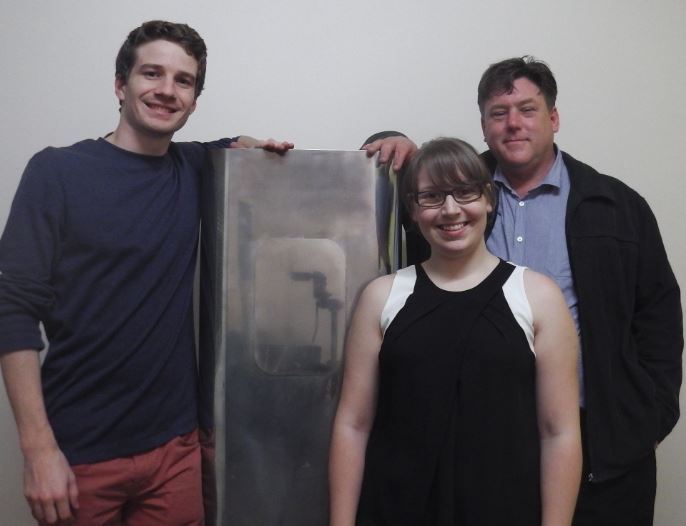 Some of the Aurora Labs team with the S1 metal 3D printer. Courtesy of Aurora Labs.
Technical specs for the system are somewhat scarce, but it has been revealed that the S1 has a build envelope of 150 x 150 x 200mm (5.9 x 5.9 x 7.87 in.), and uses two powder feeders. The S1 is meant to be a prosumer or small business metal AM system. Additional (more expensive) systems, the S2 and S2+, add a third powder feeder or increase the build envelope, respectively. The larger envelope of the S2+ measures 180 x 180 x 500mm (7 x 7 x 19.68 in.).
The process used by Aurora Labs AM systems is direct metal laser sintering, and, according to the company, the systems are capable of working with a large number of different metal powders. The list includes 316 Stainless Steel, 420 stainless steel, Iconell 625, Iconell 718, Hastelloy C, brass, bronze, and mild steel.
Aurora Labs has a very positive view for the future of metal AM. From the Kickstarter page:
“With a machine like this the average home owner or workshop can print out parts for cars, tools, rocket motors for parts that would previously require full engineering. This allows people to make things of incredibly high technological complexity in a very simple way. We see a time in the near future where every engineering workshop has a couple of these and most homes have one as well. With this machine people can build a 10,000 pound (4,500 kg) thrust rocket motor – for about the price of a plasma TV ($500-$1,000) in materials.”
Below you’ll find Aurora Labs’ Kickstarter video.
Source: Kickstarter


John Newman is a Digital Engineering contributor who focuses on 3D printing. Contact him via [email protected] and read his posts on Rapid Ready Technology.
Follow DE






About Us · Contact Us · Editorial Team · Advertising · Privacy Policy · Subscriber Services · © 2026 Digital Engineering 24/7 · Peerless Media