Helping design and engineering professionals discover, evaluate and specify technologies and processes that shorten the design cycle and enable success.


Alert!
Digital Engineering ceased publication on July 1, 2026. This website remains available as an archive of engineering content.
For inquiries or information, please email [email protected].

Digital Engineering April 2026
In the latest issue of Digital Engineering, we take a look at the latest innovations in design for additive manufacturing, including the use of natural language inputs, social media cosplayers, and AI integration. The issue also includes a feature…

January Special Focus Issue: Design for Additive
In this Special Focus Issue of Digital Engineering, learn about the latest advancements in design for additive manufacturing, including new software tools, additive in automotive, custom medical devices, and more.
Inventor Mark Dill has developed The Cruncher, a new method of recycling failed prints into usable plastic pellets. While the name might sound like something you’d hear on a late night TV infomercial, the actual product has gone to Kickstarter for initial funding.
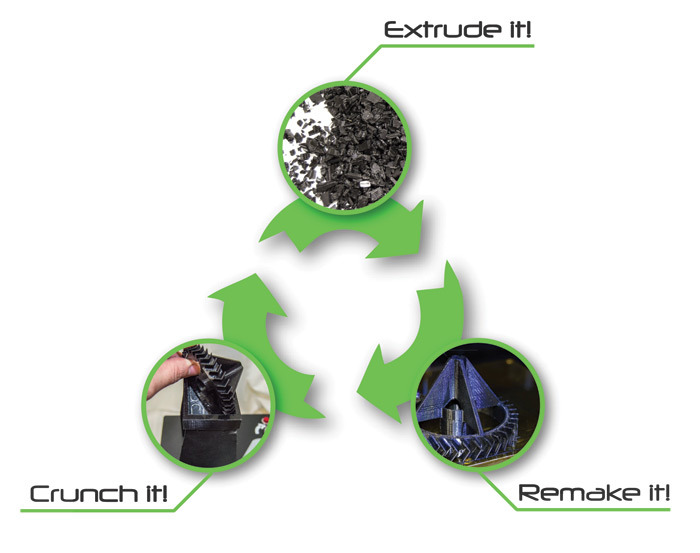
Dill isn’t a newcomer to the recycling market. He’s previously successfully Kickstarted the ExtrusionBot, which is capable of transforming raw plastic pellets into the filament used by FDM-type (Fused Deposition Modeling) printers. While a few companies have attempted to create 3D printers that only use a specially packaged proprietary filament, most FDM systems are capable of using any plastic filament of the right size and material.
Using The Cruncher and the ExtrusionBot as a combo might well save hobbyists money, once they’ve made back the cost of the recycling systems. Kickstarter has The Cruncher listed at $699 as the standard retail price, and the ExtrusionBot2 (why wouldn’t you get the newest?) is priced at $899. Some might find it amusing that those prices are higher than the costs of many home 3D printers.
If nothing else, Dill has proven there’s a market for 3D printing related goods, even pricey ones. ExtrusionBot asked for $10,000 and received nearly $89,000. The Cruncher has already raised half its $20,000 goal in just three days. Many 3D printer Kickstarters sputter and fail, by way of comparison.
The Cruncher might get even more play if it turns out the thing is capable of recycling other types of plastic objects as well. If not, it is possible to find other recycling systems designed for 3D printing. Filabot was the first recycling-to-filament system covered by Rapid Ready, and Wastestream to Mainstream may be the most eco-conscious.
Below you’ll find The Cruncher’s Kickstarter video.
Source: Kickstarter


John Newman is a Digital Engineering contributor who focuses on 3D printing. Contact him via [email protected] and read his posts on Rapid Ready Technology.
Follow DE






About Us · Contact Us · Editorial Team · Advertising · Privacy Policy · Subscriber Services · © 2026 Digital Engineering 24/7 · Peerless Media